
By R.W. Morrell
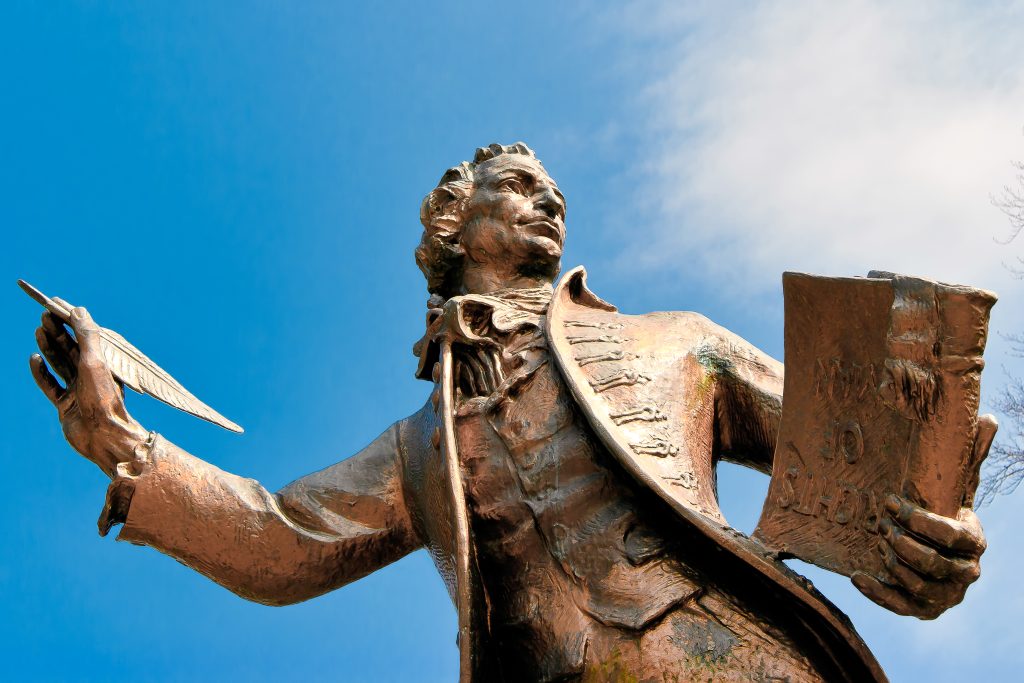
From the Sussex Express & County Herald – 12/6/64
A statue of Thomas Paine, the 18th century revolutionary was and writer, was unveiled in the Norfolk town of Thetford, on Sunday, and the ceremony attended by a representative gathering despite some local protests. Councillor J. G. Hoile, of Priory Street. Lewes,a member of the council of the Thomas Paine Society, had hoped to attend the ceremony but was prevented owing to the illness of his wife.
A member of the Thetford Council has resigned over the decision to erect the 7ft. high statue, but the guests who accepted an invitation to attend included Sir Charles Wheeler, President of the Royal Academy, who made the statue for the Thomas Paine Foundation of America to present to Thetford: Mr. Joseph “Lewis, secretary of the Foundation; representatives from the French and American embassies and members of the Thomas Paine Society tu this country,
The annual meeting of the Society will probably be held in Lewes this year.
IN DEFENCE OF THOMAS PAINE
From the Thetford and Watton Times – October 4th, 1964
IT WAS strange that a man of such historical importance as Thomas Paine had not been commemorated in a way people of lesser importance had been and the erection of a statue at his birthplace, Thetford, meant that justice was now being done, Thelford Rotarians were told on Tuesday by a member of the Thomas Paine Society.
Mr. A. A. Rudling, of Norwich, said that the Society had been formed as a counterpart to the American organisation which was providing the statue, to try to rehabilitate the reputation of Paine in this country.
The statue to Paine would attract many people to Thetford, and would add lustre to the town.
He refuted charges made quite recently that Paine was a traitor. His American supporters in the American War of Independence were almost all * of them of English origin. The American war was based upon the idea that people had the right to representation as long as they were being taxed. This was in an English tradition which went! back over centuries of English history, he said, and Paine and his friends were continuing the actions of their ancestors.
‘NO TRAITOR’
Paine was no traitor to England, nor English tradition. A great deal of blame for the whole affair, Mr. Rudling said, rested with George III and his Ministers and the English Government bore a big responsibility for the loss of the American Colonies.
Referring to the French Revolution, Mr. Rudling said that many people in England supported it and only opposed the movement when it became dictatorial. Paine at that time regarded himself as an American citizen and it was a moot point whether someone American who regarded himself could be called a traitor to Britain.
“It was easy to throw accusations about Paine which are less than just,” he said.
Whatever Paine’s views on religion his beliefs were neither unethical nor immoral, Mr. Rudling said. He was far in advance of his time in social think- ing and advocated free universal educa- tion, maternity benefits, national assistance as a social right and old age pen- sions.
He was the first man to suggest international arbitration between nations, and visualised not merely the United States but the United States of Europe: He was an advocate of social and political attitudes and institutions which today were taken for granted.
Mr. Rudling added that recent suggestions that Paine was ever tried in ‘his absence for treason were nonsense. Legal proceedings were started against him for seditious libel after the publi- cation of “The Rights of Man”, but he sought protection by going to France.