
By Christopher Brunel
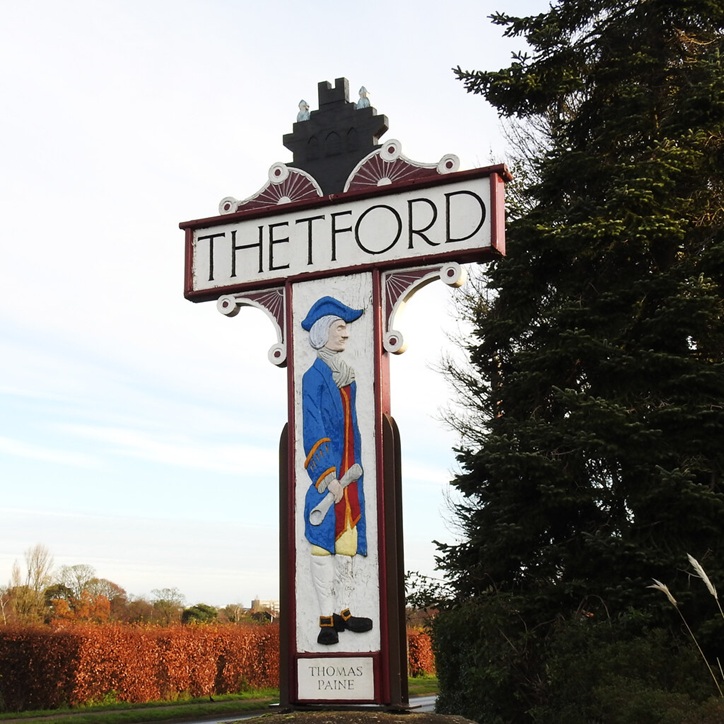
Men like G.R. Blaydon are rare – one of the reasons why he was one of our Vice-Presidents. He was first associated with Thomas Paine’s birthplace, Thetford, when he became a pupil at the same Boys’ Grammar School there, where Paine had studied. In 1890 he started work as a junior in the office of the Town Clerk, and went on to serve Thetford for the rest of his long life, becoming Town Clerk in 1923 a post he held until 1950 and a Freeman in 1940.
After his retirement in 1950, he was elected Mayor for the year 1951, the Festival of Britain, helping to organise among other civic activities the events that commemorated Thomas Paine, the man he was wont to call “Thetford’s greatest son.” On this he collaborated with my father, Adrian Brunel, and a warm friendship developed between them, for they often wrote to each other, exchanging information about Paine. Mr. Blaydon was an expert on local history, being also an Associate of the Royal Historical Society. In the correspondence appear notes on many fascinating topics of interest to students of Paine what may have happened to Paine’s bones, whether Paine was a Freemason, and details of the Rev. William Knowles, the Grammar School usher who considerably influenced Paine’s early life.
Mr. Blaydon was the author of A Short History of Thetford Grammar School,in which he showed it to be one of the oldest schools in Britain he traced the names of the headmasters as far back as 1144. He remembered Moncure Conway visiting Thetford and inspecting the Register of Freemen, where he discovered that Paine’s father’s surname ended with an “e”. Conway remarked that the discovery alone was worth a visit to Thetford, as it dispelled the idea spread by Paine’s enemies that he had added the “e” to his supposed surname, Pain, for social reasons.
My own correspondence with Mr. Blaydon, too, is full of the valuable information that he always gave with great courtesy, even when in his last years he was not always in the best of health. But my most vivid impression of him is a visual one: a fine, tall man, glowing with pride and happiness a few minutes after one of our other Vice-Presidents, Joseph Lewis, had concluded the unveiling ceremony of Sir Charles Wheeler’s statue of Paine in June 1964. It was only when he told me that he was so happy to have lived long enough to see the day, when Thetford had honoured Paine in the way it should, that I realised that this was not a young man I was talking to.
He was not just a person with an historian’s interest, for he sincerely believed that Paine should be given his rightful place in history, and he struggled many years to achieve just such an event as we had been witnessing that would honour Paine and Thetford alike.