By Christopher Brunel
AS A BRITISH institution the public house has survived such varied adversaries as temperance propagandists and television. Whether is a sophisticated city or an unpretentious country pub, one can find relaxation there – and the paradox is that there is also a great deal to stimulate one as well, (even excluding what one drinks:). People feel free to talk their minds in a British pub, and, if like Thomas Paine, you have a good ear for what men and women say about the affairs of the world, you can get it there.
Some social historians ought to dig the rich veins that I feel sure are to be discovered in our pubs, especially in their contribution to the struggles for freedom. Paine’s followers during the days of the hysterical opposition to ideas of liberty at the end of the eighteenth and the early nineteenth centuries often sound a friendly landlord, who would let them meet, discuss and drink a few toasts to the rights of man, to the liberty of the press and to so much that we today (almost) take for granted.
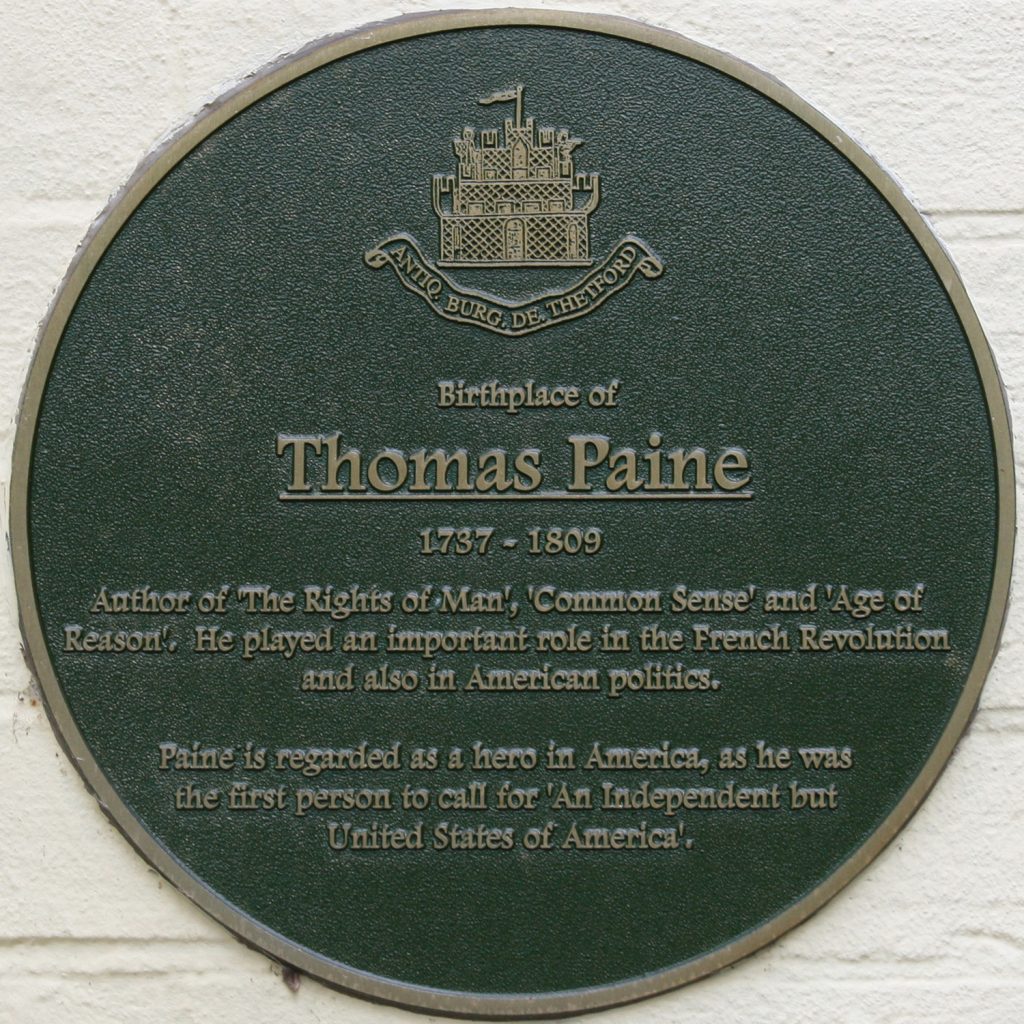
It is for these reasons that I echo our President Michael Foot’s verdict on the decision of Watney Mann (East Anglia) Ltd., to call a new pub of theirs in Paine’s birthplace, Thetford, ‘Rights of Man’ a stroke of imagination. Doubly imaginative, in fact, to get Michael Foot to perform the opening ceremony and draw the traditional first pint of beer.
Mr.Foot was introduced at the ceremony by the local director of Watney Mann (East Anglia), Mr. L.R. Canham, who said that the house was the result of a great deal of hard work, effort and imagination by a team of people. When I visited the site at Brandon Road towards the end of 1967, I saw the foundations and a foot or two of brick wall – and heard from the foreman builder some of the problems in keeping out the water of the nearby Little Ouse that somehow got into the diggings.
Now there is a most pleasing single-story building that fits delightfully into the flat countryside of East Anglia. The decor features a large number of reproductions of Paine’s works and printed material about him, which are especially well-chosen in the Tom Paine lounge bar – I hope to study them in greater detail on another occasion.
I want also to study more carefully the inn sign that was painted by Mr. E. Newsome and sign-writers in the Architects’ Department of the brewery; it shows a group of reformers, carrying a banner, inscribed ‘Rights of Man’, and it has the true flavour of the times of the struggle for liberty. If I am not mistaken, it is based on a contemporary print – it looks familiar to me, but the source eludes me (it is based on a “Criss of London” printed.).
Perhaps, when the weather improves with the Spring, a visit of Society members can be organised to visit Thetford’s ‘Rights of Man’, as well as the other associations with Paine in the town. I take this opportunity of flying this kite, and hope members will write to the Secretary with their ideas for this. I am sure that the landlord, Mr. A.L. Goldstone and Mrs. Goldstone will make us welcome. But to return to the opening, I was delighted at the way the Thomas Paine Society was given honoured guest treatment. Our President rose magnificently to the occasion with a brief sketch of Paine’s life and his greatest work, Rights of Man. “Every time I hear his name,” Mr. Foot said, “I have a glow of English pride. Some may think this is an exaggerated claim, but, if the test of a great man is how far-seeing he can be about the world in which he lives, and how he assists in liberating human ways, then I believe this claim is justified.”
Rights of Man, he continued, was the greatest democratic manifesto in the English language, and it had a bigger sale than any other book in its time except the Bible. Michael Foot, not being in Harold Wilson’s Cabinet may not have known of the current plans to reform the House of Lords, else he would have been tempted to quote extracts from Rights of Man on hereditary office-holders and legislators – there is always something topical about Paine’s writings.
The local public library – always keenly aware of Paine being born and bred in Thetford – put on an excellent little exhibition from their marvellous collection of Paine material. Most of this comes from the late Ambrose G. Barker’s collection, which Miss Ella Twynam donated to Thetford, and their selection was most apt to the occasion. The exhibits contained a number of editions of Rights of Man – and I particularly noticed how these drew the attention of one of the specially invited guests, Henry Collins. A great admirer of Paine, Mr. Collins has written the introduction to the Pelican edition of Rights of Man, that is due to be published in 1969.
Also in the exhibition was the very rare edition of part of The Age of Reason, published in Paris for M. Chateau in 1803, consisting only of Paine’s Essay on Dreams. What nobody can have realised, bearing in mind the occasion, is that this contains Paine’s warning about excess drinking.
Our President, our Society, and I, were made to feel very much at home at Thetford’s ‘Rights of Man’. The kindness of the organisers of the event will, I know, be repaid many times over in visits by members to the pub in Brandon Road, while at the same . time we bear in mind Paine’s reminder that “long and habitual intemperance” often injures the brain!