
By Stuart Brownlow
100 Years of Freethought by David Tribe. London: Elek Books Ltd.,1967. PP 259. 42/-
This book has much to commend it, at the same time it is rather a difficult work on which to comment. Central to it is the hundred years existence of the National Secular Society, but it is not really a history of the organisation.
The title thus misleads. It suggests to the casual bookshop browser that it is a history, the author, however, hotly denies this, claiming instead his work to be a social document. Yet whatever the author may or may not think, the theories associated with freethought in general and the NSS in particular cannot be seen in isolation from their historic context. This the author is forced to see as we gather from the amount of historical detail the work includes. Unfortunately in seeking to compile a social document and being forced, so it appears, against his own will to include a large amount of historical data, Mr. Tribe fails to give us a really satisfactory contribution to an important but little recognised part of recent history. In noting that the subject matter on which he writes is, “too vast”, the author cites the most telling criticism against his book. One is tempted to suggest that the work would have been far better if Mr. Tribe had set his sights a little lower and given us more detailed information on fewer themes.
There is lacking from the pages of 100 Years of Freethought certain information that would clarify some nagging questions about fairly recent NSS history. Why, for example, did his own immediate predecessor as President leave the Society? Why no mention of the short, stormy period when P.V. Morris was NSS General Secretary — indeed Morris is not mentioned.? Why was G.H. Taylor, NSS Executive Committee member and author of the valuable Chronology of British Secularism expelled from the Society? It is no answer to questions such as these, and there are many more one could ask, to claim that the work is not strictly an historical essay. The NSS is after all central to its theme.
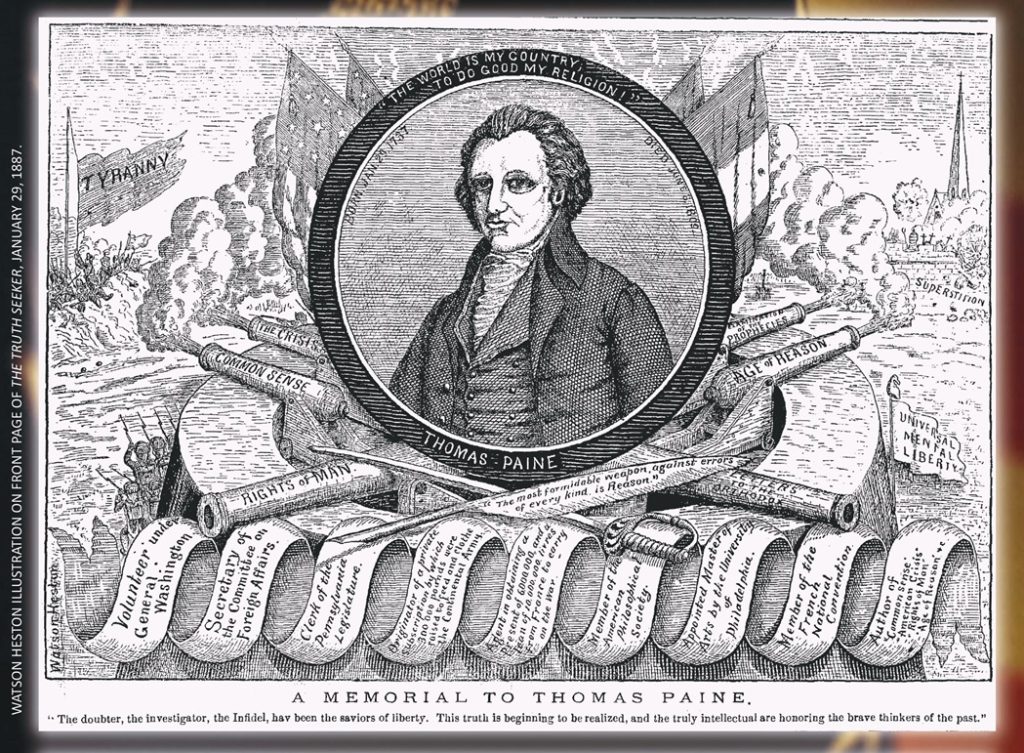
Several other points made by Mr. Tribe are open to question, not least – his explanation of Paine’s dismissal from his post as excise officer. Likewise one could question the rather cavalier contention that The Age of Reason is not a work of scholarship. By today’s standards it may not be but by the standards of the eighteenth century it certainly was and men of the calibre of Bishop Watson gave it their serious attention. Watson also attempted an answer to Gibbon’s Beeline and Fall… It is interesting to note in passing that another Bishop, Colenso„ certainly incorporated some of Paine’s ideas in his controversial theological works,without acknowledgement of course, but is not cast aside by Mr. Tribe as showing in those works a lack of scholarship.
Mr. Tribe’s work is sectionalised allowing the author to present much of his subject matter in short sketches. These sketches are historical, in the main, in outline and taken as a whole we begin to see that in recent years the NSS has acted increasingly as a medium for uniting various groups interested in aspects of social reform so that they campaign. as a unit instead of a scattered collection of organisations each operating in seeming isolation from the others. Important as such a role is in its present limited way, and if extended it could possibly bring in, or speed up the bringing about of, much needed changes, it does raise fundamental questions bearing on the future role of the NSS, questions not adequately entered into by the author.
100 Years of Freethought is an important reference work, well printed, ironically in view of its subject matter in Eire, and reasonably priced. One tends to think that illustrations would have improved it but probably its price would then have shot up. Anyone interested in the history of freethought should get a copy, however, having said this one is forced to add that the sad fact remains, the history of the past 100 years of freethought still remains to be written.