
By Ben Morreale
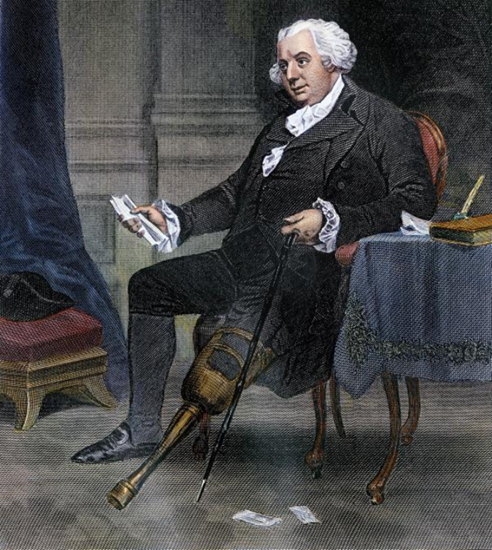
IN December 1788, Gouverneur Morris left America with many business plans, financial schemes, and a muted desire to impose his will on the political scene on both sides of the Atlantic. Before leaving, he had asked Washington for letters which would introduce him only to those persons “….who in your opinion may be useful to me.” In return he offered his services to Washington in this manner: am about shortly to take my departure from Philadelphia for the kingdom of France, and I expect to visit both Holland and England. When I desire to be favoured with your commands, it is not the mere ceremonious form of words, which you may every day meet from every man you meet, and which you may know better than any man how to estimate at its true value. Whether I can be useful to you in any way, I know not; but this I know that you may command my best endeavors.” (J.Sparks, Life of Gouverneur Morris, Boston, 1832. Vol.l. p.293.) It may have been hesitation or subtle humour, but Washington for the moment commanded Morris simply to buy him a watch in London. Nonetheless, the political and economic aspects of Morris’s mission were to grow with the intensity of the French Revolution.
Both these aspects were also apparent in the storm that broke over his appointment as American Ambassador to France. Monroe, in voting against the nomination, said, “He is a man of monarchy. He is not fit to be employed in this country 9r in France…. He went to Europe to sell lands and certificates.” (M.Conway,Life and Correspondence of Rufus Kin: New York, 1894. Vol. l. p.421.) Jefferson also protested 8 the proposed appointment of “….this high flying monarchist who closed his eyes and spirit to facts that were against his desires, who considered his wishes to be the truth and who had constantly poisoned the president’s head.” (P.L.Ford, Writings of Jefferson, New York, 1892. Vol. l. p.188.)
Across the Atlantic, LaFayette wrote to Washington that Morris was an aristocrat who had constantly expressed principles contrary to the Revolution, thus making him unfit for the post of American Ambassador. It was an opinion the LaFayette family continued to hold in spite of the services rendered them by Morris. Madame Wayette wrote in 1797 that although Morris “….saved my life he is an extreme aristocrat, and would willingly be a. counter revolutionary. I would be careful about confiding to him our present and future secrets.” (A. Maurois, Adrienne, ou la Vie de Mme. de LaFayette, Paris, 1961. Vol.11. p.358.)
Soon after Morris’s nomination, Louis Otto, French charge d’affaires in Philadelphia, wrote to his home office: “The secrecy with which the Senate covers its deliberations serves to veil personal interest which reigns there in all its strength.” And he added of Gouverneur Morris “He is entirely devoted to his correspondent (Robert Morris) with whom he has Iievn: c’Cte:tantiY.zonnected in his business and opinion…. He is perhaps the most eloquent and ingenious man of his country, but his – countrymen themselves distrust his talents. They admire but fear him.” (Archives des Affaires Estrangeres, Paris. Etats-Uhis, Vol. 35. Folder 301.) Otto ended by warning that Robert Morris and Gouverneur Morris were working to replace the French alliance with an English one.
In spite of this opposition, Morris’s appointment passed the Senate in January 12, 1792. But, then, he had powerful and ambitious men pressing for his appointment: Senator Johnson of Connecticut, Robert Morris, and Alexander Hamilton — all men who either had financial interest in fostering Morris’s diplomatic career oversaw in him one who would help them to shape-American foreign policy.’ (Julian P. Boyd, Number 7. Alexander Hamilton’s Secret Attempts to Control American Foreign Policy, Princeton, N.J., 1964. p.29.) Indeed, Morris’s actions for the rest of his stay in Europe justified the worse fears of his opponents.
One of the first to congratulate Morris was James Swan, an American merchant and speculator in Europe, who added in his letter dated:, Paris, February 1792, “The beef and pork and timber affairs rest when they were on your arrival, and with your advice or consent I shall take steps with the Committee of Marine as will force the order giving power to the minister.” (Swan to Marris. Feb.1792, Gouverneur Morris Papers, Columbia University Special Collections. Hereafter Morris Papers.) It is probable that Morris gave his advice or consent, for soon after Swan obtained, with the aid of LaFayette, remunerative contracts to furnish the French Navy with stores and salt meat provisions.
This association lasted for many years and took Morris and Swan through those grey passages where politics and financial intrigue entangled to plague the revolutionary government. Morris continued his political intriguing during his tenure as Ambassador, and there is good reason to believe that he did not permit his financial activity to lag.
Interestingly enough, many of the men who, with Morris, were involved in defending Louis XVI and the monarchy on the eve of the August 10th Insurrection were the same men who worked closely with Morris in financial schemes. It was a certain M.Bremond who assisted. Morris in much of this activity. Bremond, a Provençal, was associated with Morris as early as 1789 when Bremond sent him a_report on French finances which he had written for the Controller General, de Lambert. Both men were associated in many schemes including land speculations in America, and speculation in the French debt to German princes. (Morris Papers, Bremond Memoire. See also Gouverneur Morris, Diary of the French Revolution, Boston, 1939. Vol.11. Pp.175-195, 211-263, 269-345.) Before the 10th of August, however, Bremond ran errands for Morris, bought the correspondence of the Jacobins for him, and introduced him to such men of affairs as the bankers Schweizer and Jeanneret. Morris thought it important enough to note in his diary, January 17,1792, “Bremond reads to me a memoire upon Switzerland written by Mr.Schweizer.” It was these bankers who were entrusted with the 5000 louis d’or which the King of France had allotted for the abortive counter-revolutionary measures on 10 August 1792. Schweizer later turned up as a business partner of James Swan, who also had commercial ties with Gouverneur Morris.
For the moment, though, Morris was involved, against the advice of Washington, in counselling Louis XVI as how to flee France and how to put down the coming insurrection of August 10th. (Morris, op. cit., Vol.11, p.476.) On the 22nd of July, Monciel, minister to the King, brought to the home of Morris 547,000 livres, “of which by the second of August, 539,0% livres were already being used according to the orders of the King.” (Ibid. p.477.) The gold was divided into purses of twenty louis and was to be used to buy men willing to fight for the King, “preferably among the Marseillais,” for they would be the least suspected. Some of these men were already lodged in Bremond’s home. The plan was for these Federds from Marseille 11 “to repair to certain places and there to fight under their chiefs.” (Ibid.) Morris, in the meantime, with the aid of Monciel, prepared an address to be used to harangue the mercenaries before the battle. Morris also helped write a letter intended as a message from the King to the section of the Faubourg Saint-Marceau which, Morris noted, “will, it is supposed, give his majesty that Faubourg.” (Ibid. p.488.)
Morris’s efforts in behalf of the King and the monarchy came to nothing as the insurrection of August 10th broke over Paris. Royalists and their supporters were scattered, many taking refuge in Morris’s home. Brernond, of course, was forced to flee, but for a moment he hesitated between the offer made to him by the Fededres still lodged in his home to take him to southern France, and his first impulse to flee to England. He chose the latter, obtaining a passport with the help of the bankers Schweizer and Jeanneret, and left for England on the night of September 17. Before he left, however, he took the 5000 louis d’or and put them in the hands of Schweizer and Jeanneret. He also gave them 2000 louis of his own, “leaving them free to employ them in useful speculation.” (Morris Papers, Bremond Memoire.)
These bankers were admirably placed and, much like Morris, mixed financial and political affairs to such an extent that their influence went beyond banking circles. (J.Bouchary, Les Manieurs d’Argent a Paris a la Fin du 18 eme Siecle, Paris, 1939. p.10. (Mr.Bouchary writes: “6e furent surtout les manieurs d’argent ttrangers qui eurent une activitd extra-financiere; ce furent les Claviere, les Boyd, 1es Frey, les Guzmann, les Proli, les Schweizer….et quelgues autres qui tenterent d’entrafl-ier la France dans des aventures, soit en soutenant des contre-revolutionnaires, en formant des troubles a l’intdrieur elri dressant l’une contre l’autre.„ les faction; soit en faisant proposer des motions ultra-revolutionnaire au en poussant A la guerre contre les autres puissances europdennes.”)) As early as 1789 they were lending money to the French government through Bremond. (Morris Papers, Bremond Memoire) Their influence with the revolutionary government eventually developed so that they were sent on a political mission to Switzerland as agents of the Committee of Public Safety. Morris knew their worth, when in 1791 he ; recommended them to William Short in Holland, who was negotiating the American debt for, “They have great strength both with the Court and 41b the Assembly. (Morris, op.cit. Vol.11. p.158.)
In his long report covering the period from 1789 to 1795 sent to Morris, Bremond described his insistent efforts to recover the 5000 louis d’or. The report indicates that Bremond was interested in speculating on furniture and other goods confiscated from emigres. In spite of Bremond’s pleas, the bankers apparently tied up all- of Bremond’s 7000 louis (5000 of Louis XVI’s and 2000 of his own) in their own affairs. And indeed they were- in a good position for such affairs, for when Bremond went to Switzerland in 1794, he found them there, “charges d’une mission politique du comite de salut_public;” At the same time, these bankers were in the business of buying the confiscated property of French emigres, shipping it to Switzerland, and then on to England, where it was sold excellent prices on the fluctuation of which Bremond and M. Rougemont kept them informed. (Denis de Rougement was an associate of Frangois Jeanneret in 1785. Bouchary. op.cit., p.104.) They dealt in furniture, paintings, books, lace, and bric—a—brac. Towards the end of May 1794, however, an agent of these bankers, a M. Gattey, who was the bookstore owner in Paris, was arrested and his shop with books valued at 150,000 livres belonging to Schweizer and Jeanneret were put under scelles. (Morris Papers, Bremond Memoire.)
Bremond became quite frantic, for not only did the return of his money now depend on the sale of these goods, but M.Gattey had now been arrested. Bremond must have known that Gattey’s bookstore was a meeting place for many political groups, including the ultra—royalist Salon Francais. The frantic tone of his writing indicates that he might have known that Gattey was in the pay of d’Antraigues, head of the Royalist spy ring. (J.Chaumie, Le Reseau d’Antraigues et la Contre-Revolution — 1791-1793, Paris, 1965. Pp.46, 115.) The bankers seemed little concerned about this, although Jeanneret Sr., writing to Bremond on June 23,1794, from Switzerland, complained that his commercial affairs “n’ont pas de succes.” It was Bremond who gave them advice on how to save their property. In all this, Bremond was not only in touch with the bankers, but he must also have been in touch with Morris, for he was one of the first to know when horris had asked for a passport. And as early as August, he wrote to 2u Jeanneret Jr. that, “The Ambassador was about to leave . France.” (Morris Papers, Bremond Memoire)
Yet it was not until after the 9th of Thermidor that the activities resumed. And this we know, curiously enough, not through Bremond, but from another source. James Swan, who was now in partnership with Schweizer, apparently had been in Paris and in touch with Morris in 1794. For Swan wrote on October 11,1794, three days before Morris left for Switzerland:
“Dear Sir, In our letter of the 2nd.inst. we mentioned that we should be two-thirds interested in all rules or contracts. We mean by that only, in the contracts, as the word sales, is an error in the hurry of writing. – In any speculation you may make, we agree to be one half interested. Enclosed we send you a copy of an arrete of the comite de salut public, taken a few days since by which we are authorized to export seven million in specie value, which we shall do immediately in Barins, Muslins, Muslinettes and other British Manufactured Dry Good for 500,000. In sugars Rum and other prize goods – for 2,500,000. In super fine broad cloths for 500,000. 1000 tons eau de vie de Cognac for 1,400,000. Bordeau, a la cognac for 1,000,000. 1000 wines for 1,000,000 of whatever may be wanting or not quickly to be got of these articles, we shall supply in Bijoux, and silversmiths works, in fine linens, Cambricks, laces,etc. – James Swan and Schweizer”
The enclosed copy of the arrete of the comity de salut public, dated 15 Vendemiaire An 3 – or 6 October 1794, read:
“On the report of the commission of commerce and provisions the committee of public safety degrees
Article 1
The commercial house of Swan and Schweizer and Co. is authorized to export and sell to the account of the Republic for 7 million in metal value merchandise made up of wines, eaux de vie, luxury items and enemy prizes.
Article :11
The produce of the sale will be used to buy and import grains, wheat, rice, dry legumes, preserved meats.”
The decree was signed by “les mares du Comite de Salut Public: “R. Lindetieur de la Marne, Treilhard (A number of men on the Committee had particular interests in the goods of the emigres: Treilhard in 1793 had been sent to Manly, residence of the Capet family where he apparently stripped it of everything including the iron grills of the park, and sent to Paris “furniture rich in galoons and broidery of,. gold and silver;” adding that they would bring better prices in Paris. Ancien Moniteur, Vol. XVIII (October 23, 1793), p.173.), Delmas, Merlin (99) (This number 99 appears in the manuscript beside Merlin’s name. It may have been a code number.) Thuriot. (Morris Papers, Swan to Morris. Letter quoted as found in the Papers.)”
The economic association no doubt proved beneficial to both men. A year later, Swan wrote from America, where Schweizer was also at the time, asking Morris if he would plead the cause of American merchants whose ships had been taken by the British as prizes. Swan offered 1000 pounds for every ship released.
When this possibility of making money is added to his desire to influence political affairs, one understands why Morris remained in Europe four years after his recall as Minister to France. After all, it was for financial and political reasons that he had come in the first place.