By Christopher Brunel
If ever the magpie instinct in a man were justified, it is wonderfully justified in the case of Ambrose C. Barker, whose collection of Paine material was presented a little while ago by Miss Ella Twynam to the Thetford Public Library. The five shelves of the A.G. Barker Collection, together with other Paineiana that the library has, form an excellent source of fascinating material for students and advanced researchers alike.
There are some notes in what I recognise as Barker’s handwriting, inserted into one volume, and written about 1936. He says in part:
“Some forty years ago two Paine Exhibitions were held to celebrate the first issue of the Age of Reason. Wheeler ° wrote the introduction to one of the catalogues expressing the hope that a Paine Institute should be established in which could be gathered books, pamphlets, medals, tokens, prints, etc. relating to Paine. Nothing came of it and the two collections were dispensed, which I regard as a calamity… The coming bicentenary gives us an opportunity of remedying this… Myself beginning in a very modest way, my collection is now probably the largest in England. At my decease, I am now in my seventy—eighth year, what will become of my collection? Were a well established Paine Museum in existence, I might as well Verb sap!”
Though no Paine Museum exists, Miss Twynam has been true to the spirit of Barker’s wishes in presenting this valuable collection to Thetford, and numerous Painites will be grateful to her. The book, in which the quoted notes were inscribed, is a very rare edition of Paine’s Essay on Dreams, published in Paris in 1803 and printed by M. Chateau under the title Extracts from the M.S. Third Part of Thomas Paine’s Age of Reason Chapter the Second- Article Dream. It is one of the gems of the collection.
Last December I spent a few days in Thetford, examining the Paine material, taking copious notes, and becoming increasingly enthusiastic by what I saw. Perhaps I can now present a short and personal digest of my notes, in order to make more widely known the sort of material that is there. As will be seen; a broad variety of different aspects of Paine’s life and works is represented, perhaps with a particular richness in material, on his theological views.
Especially topical, in view of the recent ignorant representation of Paine on the British stage, are examples of religious bigotry in the 19th.century, like two illustrated eight page pamphlets, titled Extracts from the Life of Thomas Paine Author of “The Age of Reason”). One was published in Paisley in 1822 and printed by J. Neilson; it has a laureated bust, facing right, in a squared circle, and it starts with the mythical “seduction of Madam Bonneville” by Paine. The other is undated and was published in London, being printed by A. Applegarth & E. Cowper, Nelson Place, Gravel-lane, Southwark. The contents matter is the same as the other pamphlet, but the illustration shows Paine in a dishevelled state with a bottle and two glasses, (one overturned), on a table beside him.
In some miscellaneous folders at the Thetford Public Library (outside the. Barker Collection) I also came across a fine article by W.T. Stead from the Review of Reviews (undated), entitled 4 Little Homily upon a Well-Known Text, Dedicated to the Rev.Dr.Torrey This deals with the ° slanders against Paine for “taking another man’s wife” and against Colonel Robert Ingersoll for connections with publishers of “obscene literature.” In this article Paine’s relationship with Madam Bonneville is described as “the kindly hospitality shown by an old man of sixty- seven to the refugee family of his French benafactor.” It continues by referring to the libel case that Madam Bonneville brought against James Cheetham – and won – saying:
“The only man who ever imputed a shadow of obloquy to Paine in this connection went into the witness-box after Paine’s death and solemnly swore that there was no foundation for his calumny.”
This matter links with Paine’s views on man’s exploitation of women written and published by him in the August 1775 number of the Pennsylvania Magazine. This essay is little known today, and unfortunately for many years it has been known obliquely and is rarely quoted directly. It does seem to me, though, that Richard Cathie, writing in The Republican in 1822 very well mirrors Paine’s views on the subject and carries them forward:
“The freedom and independency of women is the best proof of and guarantee and independency of man.” (8th. Feb. 1822)
In this year of the fiftieth anniversary of partial Women’s Suffrage in Britain this is still so true; lip service is paid to the cause of rights of women, as it has been in the past – examples that I culled at Thetford include those of Ella Wheeler Wilcox, (“Paine….first suggested justice to women” 1st. May 1914) and of Ernest Thurtle, (“…he wrote articles attacking slavery and complaining of the inferior position of women, and others showing his ReptIlican sympathies” (July, 1936).
Perhaps 1968 will give an opportunity for reprinting Paine’s short essay, An Occasional Letter on the Female Sex.
There is a new consciousness of the importance of visual history, and the material at Thetford contains some interesting examples, including a pencil drawing in a grangerised copy of Thomas Martin’s The History of the Town of Thetford, (London, J. Nichols, 1779). The book itself shows T.Bassett’s engraving of Paine, taken from Willson Peele’s portrait; a note on the pencil sketch says, “A drawing from which Mr.Bassett engraved his plate:- I knew Thomas Paine, and positively declare this to be a great likeness Geo B B(illegible) Thetford”. e An important difference between the two is the inscription on the book that Paine is holding. In the engraving it is “The RIGHTS OF MAN”, while in the drawing it is “In the cause of Liberty and my Country the Crises and common Sense” (Note small “c”).
Also to be seen are photos of places in Paris and America, where Paine lived, of monuments and statues of Paine, and of meetings that commemorate his life.
Our Vice-President, Colonel Richard Gimbel, started a few years ago to compile a list of events held to honour Paine’s memory, often taking place on the anniversaries of his birthday, both here and in America. In 1960 he published a list of nearly 70 such events. In the Thetford Library I found evidence of six more, (four of them in the USA between 1908-10), that are not recorded in Gimbel. I use the word “evidence” rather deliberately, as some of the scraps of information maddeningly are incomplete, though the clues are enough to put anyone on the right track.
A while ago a student of Paine was surprised that I had some editions of The Letters of Junius in my Thomas Paine Library, and was equally surprised, when I explained that at one time it was believed that Junius was Paine. The real identity of Junius has not been established, though about forty people have been nominated for the title. The literature on the question is great, but two that I unearthed at Thetford are worth mentioning here: the first, Junius Unmasked: or, Thomas Paine the Author of The Letters of Junius, and the Declaration of Independence, was published at Washington, D.C. in 1872 and carries no author’s name, while the second, Thomas Paine: Was He Junius? by William Henry Burr, was published by the Freethought Publishing Company in San Francisco in 1890. I had never seen these books before, and only my short time in Thetford prevented my studying them – one of the many things I expect to do on a return visit.
Every so often a new theory comes up, too, about what eventually happened to Paine’s bones that William Cobbett dug up and brought to England. I certainly found one or two of the popular theories recorded ‘ in items at the Thetford Library, but especially interesting to me was the confirmation that the pseudonym, “An Old Daylighter”, that the author of a small booklet, Thomas Paine’s Bones and Their Owners,(Norwich,1908), cho00-2for his interesting account was J.Hunns. The source of this information is a letter to Ambrose Barker (30 August,1910) from Edward Burgess,Ltd, of Norwich, who published the booklet.
As well as items of direct relationship to Paine, the Library has quite a bit that is connected with the radical movement, especially that in Britain in the 1790s. Sampson Perry’s Argus is especially worth mention. Perry and Paine were friends in both London and Paris, so the bits of news about Paine in the Luxembourg prison have added interest, though they add little to what is known already; accounts of the activities of the London Corresponding Society and the Society for Constitutional Information (of which Paine was a member), have all the flavour of progressive political activity against a most repressive British government and its supporters. The sour taste that William Wilberforce left in the mouthes of the fighters for freedom is seen in Perry’s description of him as being “once the defender of distant slaves, now the advocate of absent lords.” (p.98. 1795).
The Library has several copies of The Jockey Club and The Female Jockey Club, (1794), for which the fearless publishers J.D.Symonds and J.Ridgway were sent to Newgate gaol, the sentences being also linked with some of Paine’s works that they published. The Barker Collection also contains The Case of Charles Pigott, (author of the Jockey Club books), published by D.I.Eaton in 1793, as well as accounts of such democrats as Eaton, William Frend, Thomas Muir, William Cobbett and others.
Later material includes The Trial of Thomas Davidson for publishing a blasphemous Libel in the Deists’ Magazine, (London,R.Helder,1820), and associated books of the same period, all of which merit study.
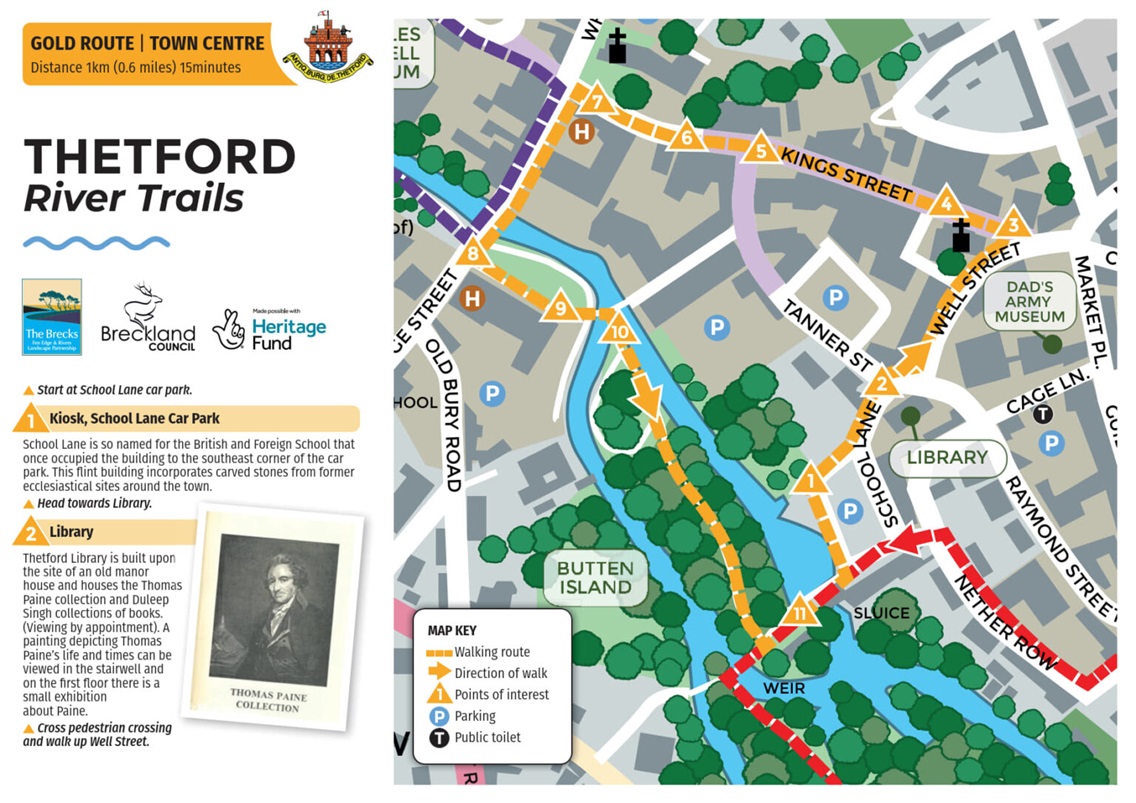
Perhaps with this admittedly rather personal survey I have whetted the appetite of others to go to Thetford. I hope so. I am, certain that they will get the same kindly and friendly treatment as I did from Thetford’s experienced Librarian, Mr. J.R. Akam, (but, as he also deals with the – Library at Attleborough the courtesy of a letter in advance would be l advisable — to The Guildhall, Thetford, Norfolk). F.H. Millington, who W. Deputy Mayor of Thetford during the Paine centenary celebrations in 1909, and whose scrap-books form part of the Paine material in the Library, and our former Vice-President, the late G.R.Blaydon„ (erstwhile Mayor and Town Clerk), are Thetford men, who have contributed a great deal to the knowledge of Thomas Paine. They have laid the local – foundations, on which today’s local Thetford pride in the town’s most famous son is being built. The local public library, as much as the fine gilded statue of Thomas Paine, is a corner-stone of this work.
Joseph Mazzini Wheeler contributed a great number of items to the exhibitions.