
A Contribution to the Study of Paine’s Influence Upon Irish History
by Nigel H. Sinnott
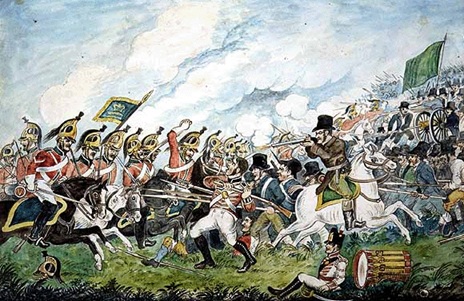
BY THE MIDDLE OF THE 1790’s all Ireland was in a political ferment which had been sparked off as a result of the success of the French Revolution abroad, and at home, the formation by Theobald Wolfe Tone (1763-1798) and others, at the end of 1791, of the Society of United Irishmen, which “at its foundation ……stood broadly on the principles of Paine’s Rights of Man (part 1 of which was published in 1791) which work, Tone notes with glee, at once became the ‘Koran of Belfast.” (Jackson, T.A. & Greaves,C.D. (1971) Ireland Her Own London. p.119.) The Society flourished particularly in Dublin and Belfast until it was suppressed (at least officially) in 1794. The following year, 1795, marked the reaction to Irish Jacobinism with the formation of the Orange Order, and was also the occasion of Tone’s leaving Ireland in the hope of obtaining help from the French for an armed uprising against the Dublin Castle authorities.
In the same year, in the city of Cork, an interesting tract was published. It was entitled Letters addressed to the inhabitants of Cork, occasioned by the circulation of a work, entitled, The Age of Reason, &c., in that city. (Cork: printed and sold by J. Haly, King’s Arms, Exchange, 1795). The pamphlet, or small book, was a defence of orthodox (Protestant) Christianity, and we now know the author to have been Thomas Dix Hincks,LL.D., an eminent Presbyterian divine of the day. I do not intend here to discuss the details of Dr. Hincks’ theological arguments, save to say that, to an inexperienced eye, they appear to be typical of scholarly defences of religion in that period. What is interesting is that Dr. Hincks should have felt it necessary to go to print at all, and it is clear on reading the preamble to the letters that The Age of Reason was not merely “circulated” in Cork, but published there. I quote:
“A work has lately been circulated amongst you with much industry, and, if I have been rightly informed, with considerable success….Had this work been permitted to take the usual course, and only one or two copies of it reached this part of the Kingdom, I should not have thought of troubling you with any remarks, but have trusted to the answers which have been or will be published in other places, and to the many excellent works which have been written in support of the evidences of Revelation. But when some persons, with a zeal which I cannot think laudable, and which perhaps deserves reprehension, have rendered it by their exertions a local publication, and have caused its dispersion amongst those, who from their situation in life, are unable to themselves to see the false reasoning it contains, it is incumbent on those, whose education and course of study have led them to investigate the subject, to endeavour to assist their brethren, and prevent them if possible from forsaking the clear and pleasant streams of Religion, for the muddy and bitter waters of infidelity.”
I have been unable to trace any surviving copies of this Cork edition of The Age of Reason, but its circulation must have been quite wide enough to worry the devout Dr. Hincks, and, indeed, his Letters ran to a second edition in the following year, retitled, Letters originally addressed to the inhabitants of Cork, in defense of Revealed Religion, occasioned by the circulation of Mr.Paine’s Age of Reason in that city. (By T.D.H.) Second edition with additions, &c. (Cork, 1796) (British Museum Cat Printed Books to 1955. I have not examined this version.)
Despite Dr. Hincks and the Government spy network, however, the illegal United Irishmen continued to spread and flourish. In 1797 we read how a number of Cork militiamen were sentenced to death and executed for taking the United Irishmen’s oath, but only after a local Scottish regiment had refused to carry out the sentence, and a more “loyal” regiment procured for the purpose. (Jackson & Greaves. Loc.cit. p.160.) This same year General Lake “dragooned” Ulster to disarm the people and terrorize the Northern Jacobins into obedience, though this failed to prevent the great risings in Ulster and Leinster in 1798, and the unsuccessful French landing in Bantry Bay later in the same year. In that year, too, Dr.Hincks had another tract published in Cork, which was entitled, aptly enough, On dwelling together in unity, a sermon (on Ps. 133) preached….on….the first of July 1798. (British Museum Cat Printed Books to 1955.)
Thomas Dix Hincks was born in Dublin in 1767, the son of a customs officer, Edward Hincks, who died in 1772. He was educated both in England and in Dublin, intended to read medicine, but decided instead to take Orders. He went to Trinity College, Dublin (? 1784); and Hackney New College (1788). His ministry in Cork lasted from 1790 to 1815, during which time he was ordained (1792), became a salaried officer of the Royal Cork Institute, lectured on chemistry and natural philosophy, ran his own school (1791-1803) and taught at Fermoy Academy, Co. Cork (1815-1821). In 1821 he left the province of Munster for Ulster, where he taught classics in Belfast Academical Institution. He died in Belfast in 1857, and was buried in Killyleagh, Co. Down. A memorial window was subsequently erected to him in Belfast’s First Presbyterian Church.
Hincks was a varied and adaptable writer; in addition to the works already mentioned he published A Greek-English Lexicon (1831, 1843), edited the Munster Agricultural Journal and several school textbooks. Of his theology, Alexander Gordon says this was “Arian, but he avoided polemics, and was on intimate terms with men of all religious parties.” (Gordon, A. (1882). Hincks, Thomas Dix. Dict. Natl. Biography 9: p.892.) Hincks was awarded his· LL.D. by Glasgow University in 1834. In 1791, the year after he came to Cork, he married Anne Boult (d. 1835), who bore him seven children, of whom five survived him. Of these, two sons achieved particular distinction: Edward Hincks (1792-1866) was a distinguished orientalist, and made major contributions to the decipherment of cuneiform script. Another son, Sir Francis Hincks (1807- 1885) was at various times of his life Premier of Canada (1851), Governor of Barbadoes and the Windward Islands (1855), and Governor of British Guiana (1862). In 1844 he launched a liberal newspaper in Canada, the Montreal Pilot, to promote, amongst other causes, “the secularisation of clergy reserves.” (Moriarty, G.P. (1882). Hincks, Francis Dict. Natl. Biography 9: p.890.) When Premier, however, his tardiness in carrying this measure through resulted in the religious Gavuzzi Riot of 1853. Sir Francis eventually published a book entitled Religious Endowments in Canada in London, in 1869.
To return, finally, to Thomas Paine. There can be no doubt that his ideas in the 1790’s (and later) had profound effects upon political thinking among Irish radicals, just as they did among the revolutionaries of France, the United States, and Britain. Both he and Wolfe Tone met in Paris in March 1797 and during the period of the “dragooning” of Ulster and the ’98 Rising, a copy of Paine’s Rights of Man was virtually a death-warrant if found in an Irishman’s pockets. (Equally interesting are unconfirmed, but reliable, accounts of a Gaelic edition of the Rights of Man which circulated in the Scottish Highlands in the 1790’s. If any collector of Paineana can run down a copy of either of the Gaelic Rights of Man, or the Cork edition of The Age of Reason, I would be very pleased to hear of it.) It is interesting to see the spread of Jacobin ideas in the 1790’s from Dublin and Belfast to Cork, where they were ruthlessly suppressed in 1798, and remained more or less dormant until the Tithe War in the 1830’s. During the Irish War of Independence (1919-1921) the County was a major theatre in the fighting, and has ever since earned itself the nickname of “Rebel Cork.”