
By Sean Cronin
_(cropped).jpg)
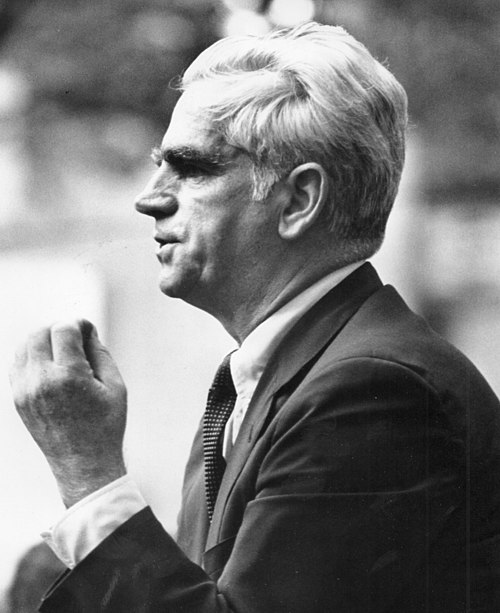
Many Americans are ambivalent about Thomas Paine, the 18th century British-American author and propagandist, for all kinds of reasons; he’s too radical in a modern way, perhaps. Paul O’Dwyer (Vice President of the Thomas Paine Society. Reprinted from the Irish Times, 25/6/1979) is not one of them. He has been trying for years to have Paine given his revolutionary due, with only mixed success, and now he is celebrating two triumphs.
The other evening, as President of the New-York Archival Society, O’Dwyer opened the “Thomas Paine Park” near the complex of court buildings in downtown Manhattan. As President of New York City Council he pushed a bill through that body to have a park named for Paine and Mayor Abe Beame signed it into law before leaving office.
“The harder the conflict, the more glorious the triumph,” said O’Dwyer, quoting the famous sentence of The American Crisis. The park sits on the old Kolleck Pond, which supplied New Amsterdam with fresh water about 350 years ago. There are sycamore trees all round and “tired lawyers and disappointed litigants” can sit in the shade, O’Dwyer remarked, after a hard day in the courts.
His second triumph was the discovery of a letter from Paine to Robert Livingston, Secretary of Foreign Affairs for the Continental Congress during the US Revolution, and President Thomas Jefferson’s Minister to Paris in 1801, pleading for US intervention in the case of James Napper Tandy. O’Dwyer found the letter in Livingston’s correspondence at the New York Historical Society.
Paine and Tandy were good friends. They could be found with Thomas Muir, the Scottish Jacobin, drinking brandy in the Irish Coffee House and talking revolution. Wolfe Tone thought they talked too much.
With the help of the influential Paine, the Directory gave Tandy a fast ship, the Anacreon, to sail for Ireland in the autumin. of 1798. Tandy was well known and his name might keep the revolutionary fires burning. He arrived off Donegal early in September to learn that the insurrection was over and Humbert had surrendered to Cornwallis. He distributed a few proclamations, sailed the next day back to the continent via the Orkneys and Norway, arriving eventually in Hamburg.
Tandy created an international incident. He held the rank of major-general in the French army. England’s ally, the Czar, blockaded Hamburg. The British demanded that Tandy be handed over and the French threatened war if Hamburg complied.
England was a great sea power; Hamburg, a port, depended upon trade for its prosperity. Tandy was handed over, put on trial for his life in April, 1801, and sentenced to death. Napoleon, then First Consul, was outraged. Cornwallis urged the Government secretly to spare Tandy. Banished to France, he died soon afterwards.
Paine’s letter mentions the Asgill incident. Asgill was a young English officer condemned to death in reprisal for some British misdeeds during the American Revolution. He was a prisoner of war and completely innocent. Washington’s French allies were shocked. Livinston, as Foreign Secretary, had to explain the case and he called on Paine’s talents. Paine blamed the British. Congress lifted the death penalty on Asgill, and Cornwallis was pleased,
The letter dated “25 Brumaire Year 10 from Rue du Theatre No.11,” opens with the salutation, “Dear Friend” and continues with Paine’s own spelling:
“I called at your apartments yesterday but you were absent. I have many things to mention to you as well as to ask of you; and when you have a leisure hour I shall be glad to make an appointment for that purpose, either at your own apartments or mine. If you can make it convenient to call upon me you will find me in any work-shop which, like the cobbler’s stall, serves me for Parlour, for Kitchen and Hall, and we shall be perfectly retired.
“But my motive for writing you this letter at this time is to engage your benevolence, and, as far as you can give it, your assistance, in behalf of an honest unfortunate old man whom you know by name, Napper Tandy, who after several years of imprisonment is now sentenced to Botany Bay.
“You remember at the time of Asgill’s Affair you were Minister of Foreign Affairs, and you will recollect a conversation you had with me respecting Asgill, inconsequence of which I published a piece upon that subject and wrote to General Washington to engage him to suspend the execution of the sentence upon Asgill,
“During that suspension the letter of Vergennis arrived asking in the name of his Court (or rather that of the Queen) a remittance of sentence, which terminates the affair, and relieved us all from a painful sensation.
“Now as you were an instrument for saving Asgill, I think you might find a way, without involving your diplomatic character, to throw in your aid to relieve poor Napper Tandy. What I wish to be done for him is to let him transport himself, in which case I suppose he will go to America, because since our Government is.reformed, the honest and the unfortunate will find Asylem there.
Neither Talyrand, nor any person in the government here, knows anything of the case of Asgill, and I think you might very consistently write a private note to Talyrand to inform him of it, and to engage him to make the government acquainted with it and to ask in return a rémittance of the sentence of Napper Tandy, for though it is not now the same government, it is the same nation.
“Cornwallis, you know,, was in America while the affair of Asgill was pending, and I cannot see any lay-propriety (keeping the Ministerial character out of the question) in your writing a note to remind Cornwallis of the circumstance and to hint to him your wish that he would be as friendly to Tandy as you had been to Ásgill.
“So far from there being any inconvenience in this, I think the contrary will be the case. It will most probably happen that you and Cornwallis will either in company or at a public audience meet, and this preliminary introduction will take off the awkwardness which might otherwise take place at a first meeting, and furnish a subject of conversation when it might be difficult to start a political one. Nothing brings people more easily together than a joint endeavour to do a good thing.
“If you are much engaged and have not the leisure to turn the whole of this affair in your mind I will throw a few thoughts together for the purpose of forwarding it; and if, while I stay here I can render you any auxiliary aid, you know there is nobody more disposed to do it than myself In remembrance of former times and former friendships. I remain,
Your fellow labourer,
Thomas Paine