
By George Spater
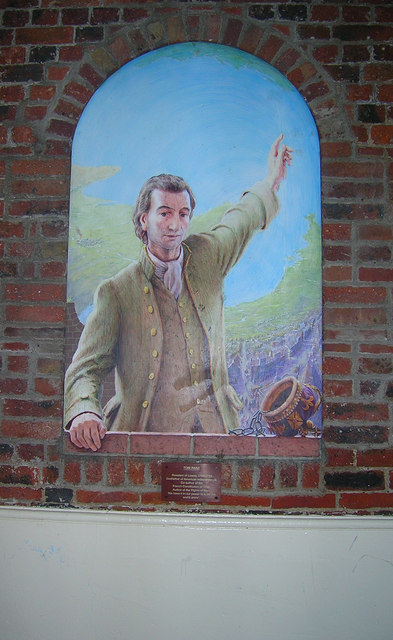
Thomas Paine migrated to America in 1774 when he was thirty-seven year old. He came armed with a letter from Benjamin Franklin which suggested that he might be employed “as a clerk, or assistant tutor in a school, or assistant. surveyor.” (1) Within two months of Paine’s arrival he was assisting in the publication of the Pennsylvania Magazine, of which he was shortly made editor.
It is evident from the first sentence of his first contribution to the maga- zine, written in 1774, that he was a writer of no ordinary talent. (2) Yet in 1777 he declared that he had never “published a syllable in England in my life.” (3)
Three possibilities suggest themselves:
- That Paine was telling the truth: that he had a great natural talent for writing which appeared full blown at the age of thirty-seven without previous exercise.
- That Paine was telling the truth: that he had written in England, but never published.
- That Paine was not telling the truth: that he had written and published in England.
We now have known for some time that in 1772 Paine had written an address to parliament, approximately 6,000 words long, in which he stated the case for an increase in the pay of men employed by the government as officers of excise. Some 4,000 copies of this address were printed. (4) Paine’s detractors claim that this proves he was lying in 1777. Paine’s supporters claim he was telling the truth, that despite the 4,000 copies printed in 1772″I was a document submitted to Parliament, but never sold,” hence not “published” until it was reprinted in 1793.(5) Apart from the issue of truthfulness, the identification of a single publication by Paine during the first thirty-seven years of his life, is hardly sufficient to explain the great writing skill he manifested from almost the first moment he arrived in America.
In 1979 an industrious researcher, Mr. G. Hindmarch of Purley, Surrey, announced the discovery of “more than forty varied articles” written by Paine that had appeared in the Sussex Weekly Advertiser; Or, Lewes Journal in 1772 and 1773 when Paine was living in Lewes.(6) The articles were signed, “A Forester.” Mr. Hindmarch’s conclusion that “A Forester” was Thomas Paine rests on three elements:
- “the internal evidence in the Lewes writings of style and subject matter.”
- “the logic of the pen-name” – Paine had used the name “The Forester” in several articles he wrote in America in 1777.
- A “comparison of the time factors” – that is, the articles and related references to “A Forester” in the Sussex paper are consistent with the period of Paine’s residence in Lewes and his visits to London in 1772 and 1773.
This concurrence of dates, however, is the only one of Mr. Hindmarch’s ?three clues that stands closer examination. Taking first the “internal evidence” of the Sussex articles, their most patent characteristic – the one that most immediately strikes the eye is their generous embellishment with literary quotations, particularly from Ovid, Virgil and Horace in the original Latin. At least thirty examples of such classical quotations occur in the forty-odd articles discovered by Mr. Hindmarch, and numerous other literary quotations appear in these articles. In contrast, Paine’s acknowledged writings are devoid of such literary embellishment. He rarely quoted others. When he did it was ordinarily used as a fact to which he might reply, not as a decorative device. As to Latin quotations, I do not recall a single instance in which Paine made use of one; if he ever did, it was an extreme rarity, and his lack of knowledge of the language was notorious.(7)
Nor does the substance of the “A Forester” articles support the conclusion that they were written by Paine. Not only do they extol revealed religion, as Mr Hindmarch points out, but they attack free-thinkers and scientific research.8 Furthermore, they are moralistic and pietistic, characteristics not found in Paine’s acknowledged writings.
An even more serious objection relates to what Mr. Hindmarch has called “the logic of the pen name.” In addition to the 1772-3 series of “A Forester” articles discovered by Mr. Hindmarch, other articles under the same signature appeared in the Sussex Weekly Advertiser; Or, Lewes Journal in 1787-9, from 15 to 17 years after the first group of articles.(9) These later articles are also consistent with Paine’s dates, since he returned to England in 1787 and remained there, off and on, until 1792.(10) If this element alone is considered, then there would be strong evidence to support the thesis that they were written by Paine. But a new difficulty arises as a result of the following notice published in the Sussex Weekly Advertiser for February 1, 1790:
“On Tuesday last, after a few days illness, died, the Rev. Richard Michell, of East-Dean, author of the many letters that have appeared in this paper, under the signatures of A Forester, and The Man of the Rocks…The subscribers to the works of the deceased (which are all printed) will shortly have notice where to apply for their books.”
This does not, of itself, dispose of the possibility that there may have been two “A Foresters”. One who wrote the 1772-3 articles and another (Richard Michell) who wrote the 1787-9 articles. However, the likelihood of such duality is reduced by two other bits of evidence. First, at least two of the “A Forester” articles that appeared in the later period were largely copied from “A Forester” articles that appeared in the earlier period. (11) Second, the posthumously issued volumes of the works of Richard Michell include as one of his articles, a poem which had appeared in the Sussex Weekly Advertiser for October 4, 1773.(12) A suspicious mind might ask whether the Reverend Richard Michell may have been guilty of robbing the original “A Forester,” but such a possibility is minimised by the fact that William Lee, the editor of the Sussex Weekly Advertiser, where all the “A Forester” articles appeared, was not only the publisher of Michell’s posthumous works, but also the printer of Thomas Paine’s pamphlet of 1772. Nor can we forget that the “A Forester” articles sound much more like the writings of an intelligent vicar of the Church of England than that of the intelligent deist, Thomas Paine.
Thus the weight of the evidence that we have at the moment suggests quite strongly, if not conclusively, that the “A Forester” articles of 1772-3, as well as those of 1787-9, were written by the Reverend Richard Michell, and that they were not written by Thomas Paine.
References
- Conway, Moncure. The Life of Thomas Paine. 3rd edition. I .p.40.
- Foner, P. The Complete Writings of Thomas Paine. II. p.16.
- Foner. I. p.72.
- Foner II. p.1129.
- Conway.1 .p.49.
- TPS Bulletin. 6.3.
- “I did not learn latin”: Conway. 1.12. The phrase, “ultima ratio regum,” was twice used by Paine – Foner. 1 pp.58 & 398. In several instances he used lines from English poets as mottos for his articles. See, for example, Foner 1. 58, II.33 & 34. For examples of other uses by him of English poetry, see Foner II. 625,958-9.
- See, for example, articles 2 and 23 November 1772.
- Articles appeared on the following dates: 14 and 28 May, 18 June, 16 July, 6 Aug., 3 and 24 Sept., 25 Oct., 3 and 24 Dec., 1787; 21 Jan., 12 May, 16 and 30 June, 28 July, 25 Aug., 15 and 29 Sept., and 27 Oct., 1788; 26 Jan., 2 March, and 31 Aug., 1789.
- Paine, however, did not return to England until late in August or early in September 1787, several months after the second group of articles began to appear.
- Article of May 12, 1788 copied from those of 5 and 12 April, 1773; article of June 16, 1788 copied in part from article of October 26, 1772.
- The works of Michell were published in a volume entitled, Fugitive Pieces, on Various Subjects by Richard Michell, Curate of Friston and East Dean, in two volumes, Lewes, 1787. Despite the date, the volumes appear to have been published in 1790. Friston and East Dean are neighbouring villages not far from Lewes. A brief summary of Michell’s career is given in Alumni Cantabrigiensis, compiled by J.A. Venn . C(1951), part II, Vol.IV. p.404.
GEORGE HINDMARCH COMMENTS
WHEN MY PAPER, “Thomas Paine: The Methodist Influence,” was written I considered adding a supplement outlining the circumstances of the second series of articles submitted to the Lewes Journal by the Rev.Richard Michell over the pen-name “A Forester,” and indeed began the draft of this supplement; but I did not attach it to my paper because:
- That paper was reasonably complete in itself as an account of the Methodist influence on Paine.
- I was satisfied that the Michell articles comprised a separate episode, although Michell plagiarised Paine.
- The relationship between Paine and Michell is quite complicated and can only be dealt with by a second paper of considerable length.
I pointed out the existence of the second series of Forester articles to the editor of the Bulletin, and asked to be allowed to comment on any views dissenting from my paper which might be submitted to him for publication. There were no such views at the time, but Mr. Spater has now raised the question of Michell, and it appears to me that it may be best for me to write my own interpretation of the two Foresters – a considerable task – and submit it to the editor for his consideration. This paper will entail a survey of other aspects of Paine’s sojourn in Lewes, and will include material not previously published to my knowledge.
At the moment however, I would like to make two brief comments:
First, I included in my paper published in the Bulletin (6.3.1979. 37) the full text of a letter by Paine, writing as the first Forester, which épadiudad with the explicit undertaking:
However, to guard against all misunderstandings for the future, in A MATTER OF SUCH MIGHTY IMPORTANCE, I take upon me to affirm, and I can affirm it with truth, that as I never have, so I never will send any thing to the Paper, but under one and the same Signature, namely that of:
– A FORESTER.
This affirmation in itself goes a very long way to establishing that Michell, who is known to have written to the paper under two quite separate per-names, could not have been the first Forester.
Second; comparison of the first hesitant plagiarisms with the vivid original also discloses that the two Foresters were quite separate. Michell was born in Lewes in 1741 and received deacon’s orders from the bishop of Chichester in 1766; there is no known indication that he ever lived in London and hence could only describe events there at second-hand. Paine lived and worked in London as a stay-maker, and would have been given the Tyburn holidays to watch the public executions, to which as an arrival from the countryside he would have journeyed with the crowd.
Paine vividly recorded his reaction, and I included his comments in my paper, but for convenience of readers I repeat them here:
Can anything set in so striking a light the callous insensibilities of an unfeeling heart, as the number of happy faces to be seen on those melancholy occasions. Every street (through which the poor outcasts of society are to pass) lin’d with crowds of people, and most of them as talkative, and full of glee, as if they were going to the exhibition of some public shew. And (to make the scene quite complete) you see bakers carrying along immense loads of pastry, for the spectators to regale themselves with. O sacred sympathy whither art thou fled? Dost thou reside with the Cherokee Indians, or hast thou taken shelter in some of the deserts of Africa?
Now compare the words of Michell as he began his plagiarism of the words Paine had published fourteen years earlier:
In proof of our being, great numbers of us, too capable of regarding with the eye of indifference the difficulties of others, I might safely appeal to the immense crowds that are known constantly to attend the public execution of criminals…. Shall even our want of feeling promote trade? Yes, at these times it actually does. It is enough indeed to put a man out of conceit with his own species, but I am really told, that the bakers, on exécution day, always provide an amazing quantity of hot plumb-pudding, for the spectators to regale themselves with… may I not justly exclaim, “Tell not this in Gath;” let not the wild savages of America hear a syllable of the matter,lest they be obviously led to conclude, that with all our boasted superiority, and after all our pretension to refinement, we are still nearly or quite as unciviliz’d beings as they are themselves.”