
By Willoughby Jarrell
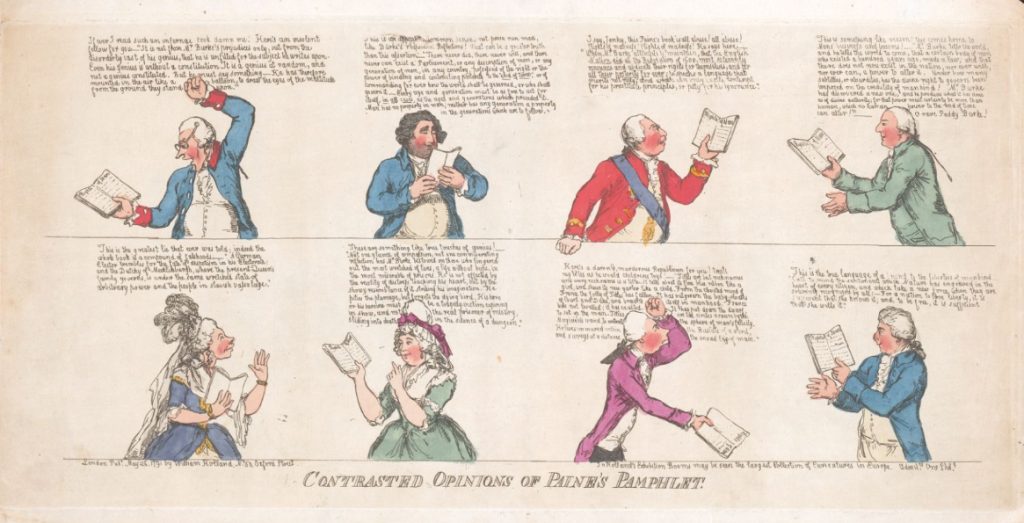
THIS PAPER CONSTITUTES a portion of a larger endeavour to trace the roots of the political thought of Thomas Paine. The purpose of this larger project is to illuminate the many traditions upon which Paine drew in order to more confidently ground and appreciate those traditions of thought which claim Paine as a central figure of influence. The traditional way of looking at Paine as an Enlightenment political propagandist or as a Newtonian Deist is not sufficiently explicit enough to distinguish him from others in that category.1 Nor do these general descriptions of Paine enable one to explain why Paine appeals to such a wide variety of radical, liberal and even some conservative causes. Similarly, attempts to derive the core of Paine’s political thought from Locke, Rousseau and Hobbes have broken down under modern interpretations of the social contract theorists coupled with a more than superficial examination of what Paine says.2
Three rather important shifts in scholarship in the last fifteen years have made it possible to reassess the writings of Thomas Paine from a new and more profitable perspective. First has been the re-evaluation of the influence of Locke on the English and American traditions of liberal dissent. This opened up in many areas the possibilities for seeking non-Lockean derivations for elements of dissenting thought. Secondly, the studies of Pocock and others have paved the way for identifying through the civic humanist paradigm a more comprehensive approach to identifying strains of political expression. Thirdly, the movement in more recent scholarship linking the issues and language in English opposition discourse from the Civil Par to dissent in the Revolutionary Era of American politics provides a chance to look at Thomas Paine as perhaps an important link in this tradition.3
Most recent scholars have placed Paine somewhere in the radical tradition of dissent concentrating specifically on those aspects which derive from the English tradition.4 Some writers have suggested the debt that American dissent during the Revolutionary Era owed to the conflicts of the seventeenth century. They push the roots of American radical dissent back to the Levellers, especially to Lilburns, Winstanley and Overton. Others trace American dissent back to the writings of the British Commonwealthmen, especially Burgh, Macaulay, Clarendon and Sydney. The language of debate took on a neo-Harringtonian tone illustrated nicely in the writings of Trenchard and Gordon in the early eighteenth century.
The writings of Trenchard and Gordon, especially Cato’s Letters and The Independent Whig, deserve a special place in importance. Clinton Rossiter proclaimed Cattle Lettern more popular and quotable than Locke’s Civil Government in the American colonies.5 Bernard Bailyn suggests that the writings of Trenchard and Gordon in addition to Locke provided a vehicle for the transportation of English opposition thought of the early eighteenth century into American revolutionary thought.6 Jacobson traces the “radical Whiggish” posture of Trenchard and Gordon partially to Algernon Sidney, who had previously spelled out arguments for the rights of resist- ance to tyrannical power. Trenchard and Gordon embellished upon Sidney’s theme adding opposition to hereditary rule as well as papal influence to their own writ- ings. The writings of Tronchard and Gordon addressed themes which captured the American interest: separation of church and state, rejection of divine right of kings, resistance to tyranny. They were read by Adams, Jefferson, Dickinson and Franklin just to name a few among the influential. American revolutionary writers.It is obv- ious from assessing the differences from among the aforementioned Americans that each of them chose what they wanted from Trenchard and Gordon and were not more parrots of Cato.
A few scholars on the basis of some astute educational hunches have begun to link Thomas Paine with various of these traditions of English dissent. Henry Yorke charged that Paine’s political writings said nothing which “is not found in the writings of Sidney, Harrington, Milton and Buchanan.”7 Paine’s idRas on human rights have been traced more to the English Levellers than to Locke.8 Hill and Foner have mentioned similarities between Paine and the Levellers.
Pocock9 and Jacobson10 mention that Cato’s Letters may have influenced Paine’s pamphlet, Common Sense. A closer examination of this assertion is an important one to me for two reasons: a person can use the analogy between Paine and Trenchard and Gordon to find out if there really is a substantial basis for linking Paine with the English tradition of radical dissent in general. Secondly, through the personage of Paine there can be a vehicle for the transmission of radical dissenting ideology and language into American radicalism. Where Paine diverges from Trenchard and Gordon there may be an opportunity to link him with other figures in English dissent as well as Scottish figures. Parts of my research excluded from this paper have explored the more detailed areas in which Paine espoused and diverged from the traditions of dis- sent expressed by the Levellers and later by Algernon Sidney.
This paper concentrates on Paine’s connections and the possible debt to the writ- ings of Trenchard and Corion,especially as they appear in Cato’s Letters.To compare with Cato’s Letters I have selected Paine’s pamphlet Common Sense, which was his first major tract which drew upon a wide assortment of political, social and economic ideas.
Paine and English Traditions of Radical Dissent
The first section of this paper lays the groundwork for Paine’s possible contact with elements of English radical ideology.
Paine was born and raised until the age of nineteen in Thetford in Norfolk,England Williamson relates that Norfolk, and especially nearby Norwich, had long been a “center for liberalism and dissent, some of it dating back to the Levellers of Crom- well’s time…. The child of Norfolk with an independent mind and spirit could hardly fail to register some of the influence of his country’s radicalism.”11 Foner attests to the possible contact that Paine had with underground radical ideas in London and Lewes when he was there in the late 1753.12 He mentions that Paine read the paper of Lewes which often expressed anti-monarchical sentiment. Paine worked with the Excise service in Lewes in 1768 and was active as a Whig in Lewes politics. Williamson relates further that from 1754 to 1774 Paine followed the activities of John Wilkes, even reading his paper, The North Briton.
Perhaps the Wilkes’ cause is an important link between American radicalism and British radicalism which can be traced through the personage of Thomas Paine. Paine’s personal experience as an excise officer and his familiarity with the Wilkes movement may have combined to inspire him to write the Case of the Officers of Excise in England (1772-73). In this piece, Paine pleads to Parliament for higher wages for those working in the Excise service. He lost his case and on the basis of what he knew about the Wilkes’ case could very well have formed the lasting impression that it was futile to work within the existing British political institutions for change. In addition, Paine’s observations of the influence of the ministry and the king in the Wilkes’ case could have acquainted him with the realities of the king’s power over his ministers.13 It seems that Paine had already made up his mind when he came to America that England under the existing king and ministry would not redress the grievances of the colonies. This may help explain why Paine directed his attacks to the king of England in Common Sense instead of copying Cato’s preoccupation with a corrupt ministry. The Journal of Radical History. At this time Paine does not propagate the dominion theory of colonial status that had been suggested in 1773 by Sam Adams.
Garry Wills and Pauline Maier in independent studies suggest a connection between Americans who defended John Wilkes and also took up radical ideas.14 Maier suggests that the Boston “Sons of Liberty” identified with the Wilkes cause. She mentions that John Dickinson’s Farmer’s Letter in 1768 was a “virtual platform” for American and British Wilkesites.15 The Wilkes’ affair drew attention to the need to restore the balance of the British constitution, reform the laws regarding taxation, bankruptcy and indebtedness, and redistribute representation to include people with moveable property. Brewer mentions the possible connection between Wilkes’ economic reforms and the encouragement of anti-aristocratic feelings. “The followers of Wilkes saw politi- cal reform as part and parcel of a reordering of social and economic relationships in English society, to facilitate commercial relations and to provide for a policy of independent men of small property ruled by an accountable (and incredible weak) state.”16
Maier contends that part of the American acceptance of Paine’s Common Sense lay in the possibility that they had held the king responsible for the Wilkes’ affair and were already conditioned to accept government “malfeasance -and corruption” as part of their problem with Britain.17 Maier reports that at about this time a few Americans were beginning to shift their hopes for appeal from the king’s corrupt ministers to the king. If their problems were then not supported and redressed by the king, they were psychologically prepared to accent the thesis that the entire British government was corrupt, endangering the British Constitution and liberties.
Foner suggests that “Common Sense did express ideas which had long circulated in the colonies — the separateness of America from Europe, the corruption of the old world and innocence of the new, the absurdity of hereditary privilege and the possib- ility of a future American Empire.18
Many American pamphlets in the 1760s and early 1770s used the language of the British Commonwealthmen.19 Especially in Virginia Cordon Wood traces a preoccupation with “corruption, virtue and luxury.”20 Many of the colonial pamphlets appearing between 1764 and 1776 were asserting demands for equality within the British empire as well as locating the chief causes for corruption in the “personal avarice of the English executives and agents.”21
Two years before Common Sense American articles began to use harsh language against the king such as calling him “son of a whore.” Maier also reports that about this time articles began to appear advocating a republic in America.22 Bailyn notes that the language in some pamphlets in America in the 17603 and 1770s began to assign America a special role as a refuge for liberty and a special place to carry out Cod’s will for freedom.23
Beginning in the 1760s early American revolutionary sympathizers such as Franklin, Price, Priestly and Burgh met at the London Tavern to share ideas Paine met Burgh, Price and Priestley at Franklin’s Club of Honest Whigs in London.’24
Paine had arrived. in the American colonies from England toward the end of November, 1774. He bore a letter of introduction written by Benjamin Franklin. Robbins reports that Paine was a sort of “political son” of Franklin, who no doubt had informed Paine of the ideas shared by the Honest Whigs. Paine was writing for the Pennsylvania Magazine in Philadelphia by the spring of 1775 and could also have been reading selections from Bradford’s bookstore which carried items such as The Spectator, The Tatler and Steele’s Guardian.25 Foner reports that when Paine wrote for the Pennsylvania Magazine he wrote on to ‘es such as manners and virtue consistent with the writings of the Commonwealthmen.26
In October 1775 Benjamin Franklin reputedly gave Paine a collection of materials to serve as a basis for Paine writing a history of the American and British transactions. Paine relates that he then formed the outlines of Common Sense and wrote the first part.27
The pamphlet Common Sense was published on January 10, 1776, and was signed “written by an Englishman” on the title page. An appendix to it which addressed the king’s speech to Parliament appeared on February 14. Since few people knew who the im- mediate author of the pamphlet was, others such as John Adams and Benjamin Franklin were at first given credit for it.
Paine cites very few sources in Canon Sense. He refers directly to Burgh’s Disquisitions, Dragonetti’s essay on “Virtue and Rewards” and Milton’s Paradise Lost.28 Paine’s exposure to other thinkers of his day might shed some light on possible paths for the formation as well as the transportation of his ideas from England to America. There is no direct evidence from Paine that he ever read Trenchard and Cordon. It is possible that he could have come in contact with their writings either in England or America.
Three colonial papers reprinted sections from their writings in the 17’b. Paine was well acquainted with both Franklin and Rush at the time he composed Common Sense, so quite possibly could have come in contact with the content of Cato’s Letters first hand.
Since Paine cites James Burgh and Jacobson observes that Burgh himself lied borrowed arguments and facts from many sources and frequently used the pithier phrases of Trenchard and Cordon in his world;29 it might be fruitful to examine some possible connections between Paine and Burgh.
Since Paine cites Burgh, I thought that a comparison of the two would yield some common concerns.”30 Paine recommends Burgh for his proposals for a broad based and equal suffrage. Paine agreed with Burgh’s position on suffrage reform. They both designate the role of government as a moral instrument assigning practically the overall goals to government: preserve order, public morality and encourage prosperity. They assume the influence that national character exerts over national government. Paine takes Burgh’s enthusiasm for voluntary associations to guide reform seriously enough to propose that most problems in social living be dealt with through voluntary associations. He suggested that a national association be formed to frame a constitution for the colonies. Both stress the need for social stability and opposed associations such as parties and factions that tend to divide the public. They both advocated an expansion of sea power and Paine’s emphasis on the navy rather than the army for defense could have come from Burgh, though Burgh does share this with Teeneeerd are: Cordon. Paine and Burgh are champions of protections of civil rights, especially rights of oppression. The Cato Letters share their interest in protection of civil liberties.
Where Burgh and Paine differ is typical of the split between. British and American radicals. First, Burgh, for all his language about virtue and corruption, appears to be a constitutionalist when it comes to proposing actual plans for reform. He was convinced that the ancient constitution could be restored if parliament reformed itself internally and broadened the franchise. Secondly, Burgh favoured internal reform within the British empire of its policy toward the colonies; hence, he opposed colonial independence. Burgh is consistent with the Cato Letters on this policy. Thirdly, Burgh blamed the military rather than the monarchy for the corruption in the British government. He felt that ministerial reform could restore the balance of power within the British constitution. Burgh, like Trenchard and Cordon, supported limited power being held by an aristocracy and a monarchy. His emphasis was more similar to Wilkes, who he supported, in wanting to extend the involvement of the non-aristocratic sectors of the population in government. Where Paine does not actually differ from Burgh he appears to be more liberal, especially in suffrage reform. Though Burgh is very important to the American cause, his importance to Paine cannot be established without a more thorough comparison of their repetitive works. This endeavour is outside the scope of the present study and will be completed, at a later date.
Many general themes that appear in the writings of Trenchazd and Gordon appear in the writings of Paine. The anti-clerical theme which John Adams found so appealing in The Independent Whig, will not appear in a fully developed pattern in Paine until his Age of Reason (1794 and 1796). What Adams liked in Trenchard and Gordon, he found abhorrent in Paine. This may indicate that Paine either radicalized some of the doctrines shared with Trenchard and Gordon or else Paine drew from another tradition of religious dissent. Paine shares the concern of Trenchard and Cordon for a needier agrarian reform, or an “Agrarian Law,” but he did not develop this theme in depth until Rights of Man (Part 2, 1792) and Agrarian Justice (1797). There are still enough themes that appear in both Cato’s Letters and. Common Sense to encourage comparison. Although the very title of Paine’s pamphlet Common Sense was allegedly suggested to him by Benjamin Ruch, the inspiration for the title could well have sprung from Cato’s Letters both in the way Trenchard and Gordon used the term and the nume- rous times the phrase appears. In general, in Pocock’s words, “they all share an objection to the world of absolute authority – absolute monarchy and the world of superstition and priestcraft.”31
Nature of Man and Origin of Government
Cato and Common Sense both profess an optimistic view of humanity. They assume the innate moral and natural equality of all men. Cato accounts for differences among people by referring to Fortune.32 Common Sense by people’s exposure to different circumstances. Both use the language of civic humanism with references to virtue, corruption and fortune. Cato and Common Sense trust the innate judgment of the masses objecting to political distinctions which elevate some people arbitrarily over others.33 They make a connection between the nature of people and the nature of the Governments. Cato warns of the tendency to corrupt public officials and government to corrupt the otherwise honest masses of people. Common Sense warns that the institution of monarchy alone is enough to corrupt and impoverish a nation. Since Cato feels that the people are susceptible to being misled or corrupted by corrupt leaders, they need a decent prince to manage them rightly.34 Cato becomes the skeptic when he admits that people (abstractly) may be basically good, yet should not treat each other.
Where Cato leaves it to unvirtuous magistrates to lead the good people astray,Coe- mon Sense is afraid that the inherent moral weakness (human frailty) of people will tempt them to subvert their own liberty and security. This can occur when people lose touch with their innate sense of benevolence and fair play. All other things being equal, however, Common Sense trusts the people.
Many impulses drive people into political society. Cato and Common Sense acknowledge the human need for companionship and dependence upon others for physical survival.35 Cato pictures people joining into society and government simultaneously. He sounds Hobbesian (and in fact cites Hobbes) in originating the formation of government out of fear of individuals for each other. He puts people through the process of the social contract by asking each to surrender a part of his individual property to a magistrate who is empowered to apply the “united Force of the Community” to provide security and freedom for all members of the community.36 Cato still sees people as “subject” to governmental authority.
Common Sense separates between the forming of society “which is always a blessing” and the formation of government which is a “necessary evil.”37 In the formation of society Common Sense takes and his foundation a charitable and benevolent moral sense. Paine uses the moral sense in a manner that seems akin to Francis Hutcheson’s use of it. Garry Wills points out some portions of Common Sense that place the origin of the social contract in feelings.38 Wille’s approach makes much more sense to me in appreciating Paine’s vantage point in talking about the formation of society. It is the natural social urge that identifies the good of ethers with one’s own survival that originally impels men into society. Paine could not conceive of a “contract” anal the surrender of power implied in the Lockean social contract. Paine never alienated the ruler and the ruled in the style of Cato and other social contract theorists. Paine’s portrayal of the role of society follows the pattern of Hume and Hutheesen.39 It is the failure to retain moral sense in Society that leads Cession Sense to suggest that people formed a government to substitute for deficiencies in moral virtue. Simply, the government assumed the burden for moral guidance when people became distracted with other things.
Paine makes the distinction between the origin of society and the formation of government. He draws on other traditions by using three different theories for the origin of government. When speaking of the origin of monarchy, Paine combines the force theory for the institution of kingship with the divine theory for hereditary succession. By associating the origins of hereditary power with original sin Paine is activating anti-popery feelings associated with the Catholic church and coupling these to resentment against monarchy, especially the Stuart monarchs. For Common Sense “monarchy is the property of government.”41 Next, when Common Sense walks the reader through the state of nature into the formation of government he alludes to social contract language in only one phrase about the individual surrendering a part of his property to furnish means for the protection of the rest.”42 In finding a way to apply the prevailing notions of his time for the formation of the state, Paine widens the appeal of his arguments to a larger audience. Though they arrive at the formation of society and the state differently, both Cato and Common Sense agree th- at the institution of government should not put people in a worse position than they were without it.43
Structure of Government
Cato and Common Sense prefer the republican form of government founded on popular sovereignty.44 The form that this republic takes differs widely between the two.Cato wants to restore the balanced constitution which he feels has been subverted by a corrupt ministry which has caused the monarch’s power to become imbalanced. To strengthen the democratic part of the constitution Cato puts trust in the parliamentary power of the purse and frequent elections. Cato still accepts a constitutional (limited) monarchy.
Common Sense pictures a confederation type of republic originating out of voluntary associations formed by the public. This republic is headed by a rotating president who functions as a presiding officer. In many ways Paine anticipates the American Articles of Confederation which will evolve as a result of the second Continental Congress which was meeting when Paine published Common Sense.
In a republic characterised by representative mechanisms Cato and Common Sense agree that the instructed delegate model of representative is the preferred method to assure a harmony of interests between the people and their delegates. Cato puts more emphasis on correcting the mechanical deficiencies in the workings of the balanced constitution to accommodate a broader based public opinion. Common Sense goes beyond the mechanics (though he does not ignore their importance) to the source of credibility for a government: the enjoyment of public confidence which comes from genuine public support.
Both Cato and Common Sense suggest that limits of law be put on government. They feel that people need to be stabilised by a constitution and a charter (fashioned after Magna Charta) to protect civil liberties. Common Sense marvels at the sentiment that is holding the American colonies together “without law, without government”45 but was afraid that a more defined tie was needed to sustain the colonies through the future.
Common Sense consciously rejects the model of the British Constitution preferred by both Burgh and Cato. Common Sense feels that the locus of authority in the British Constitution is too confusing for people to find out who is really responsible for policy making. He accuses the British Constitution of inviting monarchical tyranny especially through the use of places and pensions. In Cato we heard objections to the over-extension of monarchical power through places and pensions, but not tied to a dismissal of the utility of the British Constitution which he contended was a valid instrument which had the capacity to correct its own imbalances. Common Sense is convinced that the Commons lacks meaningful checks over the monarchy and rejects the whole concept of a balanced constitution. Cato still invokes the classical notion of an outside consultant to remedy the defects of a constitution. Common Sense rejects this notion in preference for a simple (direct) enough structure that can be run and repaired by the populace.
Monarchy and hereditary succession
Cato feels comfortable with limited monarchy objecting strongly to absolutism and tyranny. Common Sense categorically rejects monarchy. The tone of his objections has the familiar ring of the radical dissenters during the Civil War. Common Sense also invokes the.Norman Yoke myth referring to William the Conqueror as a “French bastard landing with an armed banditti and establishing himself king of England against the consent of the natives.”46 His use of the Norman Yoke is similar in its usage to that of the Levellers and as found in the writings of Milton. The term “banditti” is fowl in Milton, Cato and Paine. The use of the terms “brutes” and “robbers” to describe corrupt ministers and kings permeates the anti-monarchical arguments from the Civil War to the Revolutionary War. Cato, however, does not appear to subscribe to the Norman Yoke myth even in the Whig sense of invoking the common law. He does refer to the Ancient Constitution in favorable terms by picturing the kings as too weak to corrupt or force their policies on others.47
If one takes Common Sense’s”arguments against monarchy and compares them to Cato’s arguments against tyranny then similar arguments are made, but one must recall that their similar arguments are supporting two quite different institutions. Once a monarch is branded as a tyrant than arguments pre-dating Cicero -and including Algernon Sidney sanction the death penalty for the tyrant. Paine finds the death penalty and similar violence abhorrent and proposes a different evaluation of tyranny. In Common Sense, he considers tyranny a breach of the impetus for forming a valid government, a violation of the public trust, and a justification for revolution. Hence, Common Sense could elaborate on the need for American independence and futility of reconci- liation due in part to the alienation of feelings between the inhabitants of the American colonies and the king of England.
Instead of holding the king accountable for the character and behaviour of his ministers and policy, Cato portrays his king as an innocent victim of his corrupt ministers which absolves the king of responsibility. Cato’s corrupt ministers do al- most all of the things that Common Sense attributes to a corrupt king: they destroy the liberties of the people, pursue projects that make people poor and themselves rich, engage the country in war to keep the people distracted, and finally, subvert the interest of the entire nation.48 At the heart of the misuse of power that irrit- ates both Common Sense and Cato is the dangerous tendency to promote “luxury, idleness, expense and deprivation of manners.”49 Maybe Cato could actually believe that the ministers were at the root of English corruption under George I in 1720, but Michael Foot in absolutely correct when he points out that Paine would not buy that excuse for a minute in 1776.50
Cato traces the outline of tyranny back to Roman times through Asia and other non- western parts of the world. Common Sense for the most part spares the reader the civic humanist trip through classical antiquity in preference to a son ptural argument that takes one through the kings of Israel. Common Sense concludes that “the Almighty has here entered his protest against monarchical government.”51
Once we get through Cato’s and Common Sense’s different treatments of monarchy, we find more agreement between them in their general objections to hereditary rule.Both find it an insult to natural equality, a poor way to assure competent rulers and an impetus to civil war. Both cite the examples of Holland favorably and Turkey unfavorably. Both use the term Tahomet like in an uncomplimentary way to designate arbitrary monarchical power.
Superficially, they appear to be very much in accord, but there are some differences. Cato blames the selfish interest of governors and lack of legal restraints for the plight of Turkey.52 He combines moral and constitutional arguments in his essay on hereditary rule. Common Sense denounces the ability of the constitution in either England or Turkey to restrain the monarchs. The only difference he sees between the way the monarchy acts in England versus Turkey rests on the different acculturation of the respective peoples. Both refer to the Wars of the Roses but for different reasons: Cato to illustrate the virtues of a civilian army; Common Sense to illustrate that no matter what kind of army is fighting, the tendency of monarchy is to perpetuate bloodshed.
Status of the American Colonies
Cato, like Burgh, devotes a special address to the relationship between England and the American colonies.53 They both share a preference for colonial dependence and constitutional redress of problems between the two. Common Sense breaks radically with their position.
Paine’s arguments for independence follow very closely the weaknesses in colonial policy identified by Trenchard and Gordon. Cato advises the mother country to consider the interest and advancement of the status of the colonies so that they will be treated so well and dependence will be not much to their advantage that they will not seek independence. Cato warns that colonies will not be content to draw milk from their mother when they can get better food, nor will they remain subservient because of ancestral ties.54 Common Sense takes both of these points, applies them to the relationship between England and America and uses them as arguments for independence.
Both Cato and Common Sense focus attention on the economic relationship between the colonies and England. They link individual prosperity and freedom to national prosperity and a republican form of government. They describe the ill effects of absolute monarchy and tyranny on trade, commerce and individual initiative. They agree that property and commerce are secure only in free governments. Cato uses examples from outside Great Britain. Common Sense focuses on England.
Next, Cato and Common Sense built a case for the connection between commercial growth, development of naval power and the restoration of virtue to a people. They both contend that virtuous and patriotic traits are encouraged by a seafaring society.55 They also point out that where people can work for themselves and build a stake in society, they will fight to defend that society voluntarily. Both Cato and Common Sense illustrate the capacities of small, free states to defeat more formidable tyrannical states for these aforementioned reasons.
Paine devotes almost a fourth of Common Sense to the subject of the development of commercial and naval power in the American colonies.56 In presenting a detailed outline for the colonial shipbuilding enterprise, Common Sense actually is building a practical case for the ability of America to support herself economically. Paine considers the link between commerce and defense vital.
Economically, Common Sense and Cato share some of the same concerns. Both agree that trade and commerce are basically beneficial enterprises as long as they are kept free from arbitrary political control. Both link standing armies and the tendency to corruption from luxury to arbitrary monarchies. Both see navies and the development of trade as supportive agents for individual liberty. Common Sense assumes the arguments of Cato in being suspicious of standing armies and assigns the qual- ities of virtue and reasonableness to a citizen soldiery.57 Paine seems to be aware of violating the radical dissenting position against standing militias When he develops a rationale to defend the existence of a standing navy in the colonies. Paine provides himself an escape hatch on the navy issue by suggesting that ships can be used for commerce or sold off to make money.
Cato and Common Sense part company when one looks at the overall purpose for their economic arguments. Cato wants to build economic prosperity from political dependence. Common Sense attacks mercantilism as a ruinous policy and makes a case for building economic prosperity from the base of political independence. A factor to be confronted in building economic prosperity is the question of a national debt. Cato, of course, objects to a public debt and Common Sense shares his concern that the assumption of heavy debt can invite corruption.58 Common Sense is willing to accept a temporary national debt as a means to build a navy, establish independence and encourage a national bond. He objects to perpetuating the debt onto another generation and offers suggestions for paying it off in a short time.
In conclusion, this author still cannot fit Paine into the Commonwealth tradition even when it is apparent that superficially he shares many of the concerns of the Commonwealthmen in broad areas such as preference for a republic, devotion to civil liberty, extension of suffrage and limited government. Paine’s hostility to the monarchy and the notion of the balanced constitution, place him outside even the radical commonwealthmen. On the other hand, Paine in Common Sense seems to carry on some of the language of the civic humanists. He and Tronchard and Cordon link together political inequality on some level with corruption and lack of virtue. Both are conscious of defending programmes which will discourage vice, encourage manliness and cultivate manners. Both link the destruction of manners with non—free states. The whole economic argument that Common Sense appears to make for American independence centers on avoiding the corruption through dependence that Britain has fostered in the colonies. Cato faces the dangers that a monopolistic monied interest poses to the English notion of the balanced constitution; Common Sense accepts the failure of the balanced constitution without linking a corrupt monied interest to its immediate destruction. Paine is aware that overindulgence of a nation in commercial ventures may lead to luxury and vice with the resulting inattention diminishing the spirit of patriotism and civil liberties. Therefore, rather than using this as an argument against commercial development, Paine uses it and the example of London to hasten Americans towards independence from Britain before her interests and growth turn her energies elsewhere. Paine places his bets that the overriding civilizing force of commerce nurtured by the confederated republic will contain the forces of corruption, luxury and vice.
In some ways Paine continues the neo—Harringtonian critique of corruption into the American scene and he shares the concerns of the Commonwealthmen with removing the sources for corruption, but the methods he proposes for doing this differ notably from the commonwealthmen and the English country party of his day. This is even brought clearer when Paine is contrasted to Jefferson and Adams.59 Paine may prove to be a pure descendent of Harrington and the Levellers set in the climate of the late 18th century. His rejection of the British model cf government in favour of the un-tried confederation—type republic, his treatment of commercial growth and his leanings toward Scottish moral philosophy set him apart from other radicals of his day; The most consistent theme in Common Sense is Paine’s conviction that all the economic and political conflicts between America and Great Britain have alienated their affections past the point of restoring them. Clark originally linked Paine’s attacks on monarchy to his notice of a betrayal of the innate popular benevolence.60 then labels this as the sensibility—sociability argument from the Scottish Enlightenment.”61
There is no tidy way to end this paper without pointing to two other facets of Paine’s ideas in Common Sense that need further explanation. The first is his possible dependence on the Scottish school for the economic and social underpinnings of his arguments. The second is the connection of Paine with the radical religious dissenters, Price and Priestley, and millennial thought. In several places in Common Sense Paine links American independence and republicanism with the rill of the Almighty. It may be, after all these studies are completed, that instead of appearing to be a confused and unsystematic simpleton or parrot, that Paine is an extraordinary synthesizer of some very important traditions of thought that were “in the air” at the time and of some that were thought to be dead. If these many factors can finally be sorted out through the personage of Thomas Paine, the many facets of American radicalism that claim Paine as their inspiration may be more fully appreciated.
REFERENCES
- See Harry Hayden Clerk “Introduction,” In Thomas Paine: Selections. Rev.edn. (New York. Hill and Wang 1972); Clark, “Toward a Reinterpretation of Thomas Paine,” American Literature. V (1933). 133 -145. Alfred Owen Aldridge, Man of Reason: The Life of Thomas Paine. (New York: .1.8. Lippiscott Co., 1959); Bally. “Political Experience and Enlightenment Ideas In Eighteenth Century America” in “The Causes of the American Revolution”. ed. John WahDm (Health, 1973) Tilt Journal of Radical History.
- Nelson F. Adkins, “Introduction,” In Common Sense and Other Political Writings (Indiana: The Liberal Arts Press 1953). This is the edition of Paine’s Common Sense cited in this paper; Charles Herriam, “Thomas Paine’s Political Theories.” Political Science quarterly, XIV, No.3 (September, 1899), 389-403; Cecilia ii. Kenyon.”Where Paine Went Wrong,” American Political Science Review XLV (December, 1951, 1086-99. Aldridge, A.O. “The Influence of Locke and Rousseau in Paine’s Common Sense” Paper presented to the Annual Meeting of the Conference for the Study of Political Thought, Loyola University, Chicago, April 9-11, 1976.
- H.T. Dickinson, Liberty and Property; Political Ideology in 18th Century Britain (New York: Holmes end Meier. 1977), PP.240-258; Bernard Ballyn, The Ideological Origins of the American Revolution (Massachusetts: Harvard University Press, 1977); Gordon Wood, The Creation of the American Republic (Chapel Hill: University of North Carolina Press, 1969); Stoughton Lynd, Intellectual Origins of American Radicalism (New York: Pantheon Books, 1968). For the civil humanist paradigm see especially the studies of Z.S. Fink, The Classical Republicans: An Essay in the Recovery of a Pattern of Thought in Seventeenth Century England (Evanston: Northwestern University Press, 1945); J. G.A. Pocock, The Machiavellian Moment: Florentine Political Thought and Atlantic Republican Tradition (Princeton: Princeton University Press, 1975). For language links see Caroline Robbins, “European Republicanism in the Century and a Half 1776′ in The Development of a Revolutionary Mentality (Washington: Library of Congress, 1972); Pocock (ed.), Three British Revolutions: 1641.1688. 1776 (Princeton: Princeton University Press, 1980); Christopher Hill, Puritanism and Revolution (London, 1958) Chapter 3. Cecilia Kenyon, “Republicanism and Radicalism in the American Revolution,” William and Mary Quarterly (1962), 153-182; Mordecai Roshweld„ “The Concept of Human Rights,” Philosophy and Phenomenological Research 19 (1949), 354-379.
- Lynd, Intellectual Origins; Hill, World Turned Upside Down (Harmondsworth: Penguin Books, 1975), especially the conclusion; Bailyn, “Common Sense,” in Fundamental Testaments of the American Revolution (Washington: Library of Congress, 1973); Dickinson, Liberty and Property, PP.59-269; Eric Foner, Tom Paine and and Revolutionary America (New York, Oxford University Press, 1976); David L Jacobson (ed.), The English Libertarian Heritage (Indiana: Bobbs-Merrill Co., 1965). “Introduction.” David Lovejoy, “Two American Revolutions, 1689 and 1776,” in Pocock (ed.) Three Revolutions.
- Seedtime of the Republic (New York: Harcourt, Brace, 1953), P.141.
- Ideological Origins, p.36.
- Caroline Robbins, The Eighteenth-Century Cancsonwealthoan (Massachusetts: Harvard University Press, 1961). P.3 22. during the early reign of George III.
- Roshwald. pp. 354..379.
- Moment, p.515.
- Jacobson. p. lvii.
- Audrey Williamson, Thomas Paine: His Life.Work and Times (London: St. Martin’s Press, 1973), p.26.
- Foner, pp.10-14.
- Maier, p.395.
- Garry Wills, Inventing America (New York: Vintage Books, 1978), p.45.
- Maier, p.378.
- John Brewer, “English Radicalism in the Age of George III,” In Three British Revolutions, p.361.
- Maier, pp.390-95.
- Foner, pp. 79-80.
- Maier, “The Beginnings of American Republicanism 1765-1776, In The Development of a Revolutionary Mentality (Washington: Library of Congress, 1972), pp. 99-113; Pocock, Moment, chapter 15.
- Gordon S. Wood, “Rhetoric and Reality in the American Revolution,” in John Wahlke, The Causes of the American Revolution, pp. 240-241.
- Richard Bushman, “Corruption and Power in Provincial America,” in The Development of a Revolutionary Mentality PP. 63-03.
- Maier, “Beginnings of American Republicanism, p.105.
- Ballyn. Origins, p. 141.
- Robbins. Conuonmealthman, P. 320.
- Williamson, p. 65.
- Foner, p. 72.
- Williamson, p. 76.
- James Burgh, Political DIsquistitions: or. am Inquiry into Public Errors. Defeats and Abuses. 3 vols. London, 1774-75; Glacinto (Hyacinthe), Marquis de Dragonetti (1739-1818), A Treatise on Virtues and Rewards London, 1769. See Adkins’ note on this in Common Sense are Other Political Writings, p.176; John Hilton, Paradise Lost, iv. 98-99.
- Jacobson, p. ivii.
- Works consulted on Burgh Include: Carla Hay James Burgh. Spokesman for Reform in Hanoverian England (Washington: University Press of America, 1979); Oscar and Mary Remain, “James Burgh and American Revolutionary Theory,” ProceedIngs of the Massachusetts historical Society LXXIII (January-December, 1961), 38 -57 Martha K. Zebrowski. “One Cato is Not Enough: The Rhetorical Association and the Extra-constitutional Regeneration of the Commonwealth,” no further citation available.
- Pocock Moment, p. 474.
- Jacobson, pp. 101-106.
- Adkins, p. 10 and 42.
- Jacobson, p. 64.
- Jacobson, p.82; AdkIns,11.5.
- Jacobson, p.128 and 116-18, also p.141.
- Adkins, p.4. 38. Wills, PP.303 & 315.
- Wills pp.303, 315.
- Felix Gilbert, “The English Background of American Isolationism in the 18th Century,” Willies and fiery Quarterly, 3 series 1 (April. 1944), 138-160; Wills, pp.215-17 and pp.236 -38.
- Adkins, 9.5.
- Ibid. p.14.
- Ibid. p.5.
- Jacobson, p.265: Adkins, p.4.
- Adkins, p.32; Jacobson, p.63.
- Adkins, 9.48.
- Ibid. p.15.
- Jacobson, p.122.
- Ibid. p.51.
- Ibid. p.54.
- Michael Foot, “Shatterproof Paine,” The Guardian, January 24, 1982, p.20.
- Adkins, p.13.
- Jacobson, pp.100-101.
- Ibid. pp-42-2119.
- Ibid. p.245: Adkins, p.22.
- Jacobson, pp. 152-161; Adkins, pp.37-39.
- Adkins, pp. 34.44.
- Ibid. p.50.
- Ibid. p.35; Pocock, moment, 9.469.
- Willoughby Jarrell, “Some Anarchistic Implications of the Political Writings of Thomas Paine.” Unpublished Ph.D. dissertation, Emory University, 1974. chapter 5: and Jarrell, “From Liberalism to Anarchism,. paper presented at the American Society for Eighteenth Century Studies, Tale University, 1975.
- Clark, Thomas Paine: Selections, pp.xxxvil and xxxix.
- Wills, p.303.
NOTES ON CONTRIBUTORS
Willoughby Jarrell is Associate Professor of Political Science at Kennesaw College, at Marietta, Georgia, USA. He holds a bachelor’s and master’s degree in government from Indiana University, and a doctorate of philosophy in political science from Em- ory University. He has presented several papers on Paine at conferences, and is now working on a book on Paine.
Audrey Williamson is an historian and author of several important books, including a biography of Thomas Paine and a study of Wilkes. She is a Vice—President of the Thomas Paine Society and has lectured on Paine to several organisations.
Robert Morrell is secretary of the Thomas Paine Society. A graduate of the University of Liverpool, he was before establishing his own business as a geologist. He has had a long standing interest in radical and freethought history, and has published several papers in these fields as well as the history of science.