
BY R.G. DANIELS
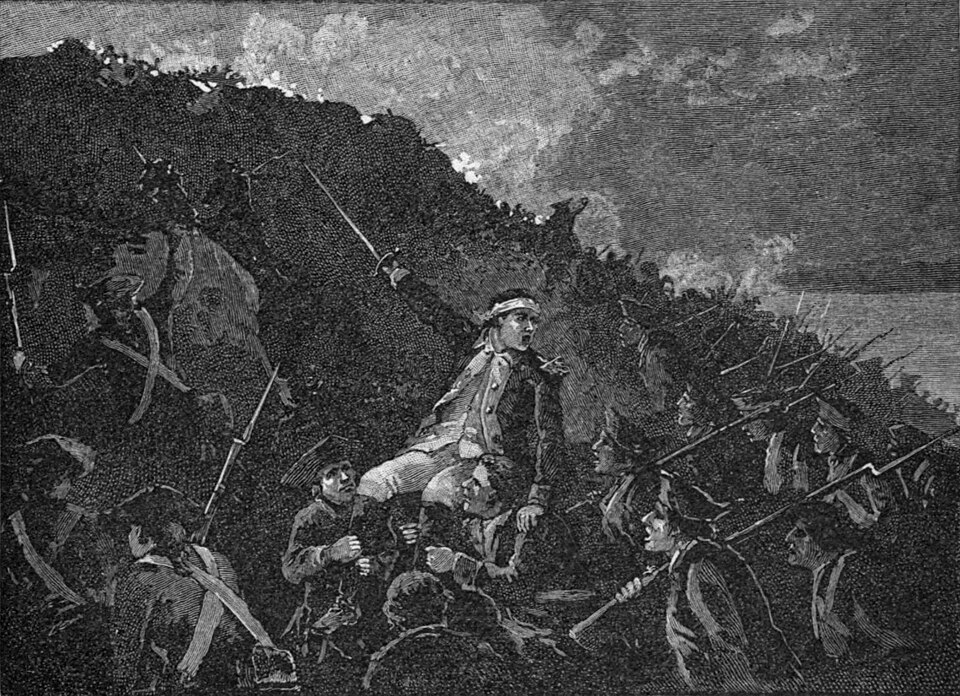

The impressions we have of fighting in the American War of Independence are largely gathered from romanticised films made in Hollywood. Indeed much of how we imagine events to have been in any particular historical period will be coloured by what we have seen in films. It could be taken even further and demonstrated that every-day life, this present historical period, is taken from files that are seen nightly in our homes.
However, the times of Thomas Paine are more remote and perspective often focuses more accurately on individuals and events. Paine knew the battlefields of the war and lust have been familiar with the death and suffering common to all such conflicts, the Continental Army was subject, as all armies were and are, to sickness as well as injury and the former disabled an average of 18% of the forces for the duration of the war. Several epidemics also scourged the army and severely decreased its fighting ability.
An article in the Tenth Anniversary of the Annals of Emergency Medicine draws together facts and impressions from the writings of the time, in particular, the Medical Inquiries and Observations, Volume 3, of Benjamin Rush, who knew Paine and with whom Paine had many discussions. (Annals of Emergency Medicine, 2.1.)
In civilian life major injuries (trauma is the modern term) were infrequent and when they occurred were usually the result of accidents with horses. There were no tall buildings, speed of travel was slow, machinery was primitive (the Industrial Revolution was only beginning), drunkeness, muggings, rape, armed robbery, the social signs of the present times, although they undoubtedly occurred they did not give rise to any appreciable load on medical or nursing services. Most illness and death was the result of disease rather than injury.
So it was the war that brought the heavy burden and toll of life and limb, liar brought the primary case-load of surgeons. But even then the injuries were the result of low-velocity, close quarter fighting weapons. Firearms and artillery were cumbersome and inaccurate and only unusually caused injury, Swords, bayonets, arrows and blunter weapons caused the majority of wounds. Occasionally overturning wagons and, less frequently, burning by fire, gave rise to injury, Indian arrows, tomahawks and scalping were also occasionally the cause of injury.
Hospitals as we know them had not developed; care of the injured was most often undertaken in private homes, barns and churches. Surgical treatment took place on the battlefield – and gave better results than surgery undertaken at a later stage.
It is recorded that men bore operations of every kind immediately after a battle with more fortitude than they did at any time thereafter. Probably the commonest operation was the amputation of a limb, undertaken for multiple fractures, infection and gangrene, and reputedly taking only twenty seconds to accomplish! This often led to the recovery of the patient, Other operations were for the removal of bullets, trepanning (trephining a hole in the skull) and the suturing of wounds. The setting of fractures was simple and crude.
Every doctor carried lancets for blood-letting, Pleurisy, for example, typically required the removal of twelve ounces of blood from the jugular vein.
The surgeons themselves (every British regiment had its own surgeon and the Americans soon followed), were not trained doctors; rather they were technicians trained to do certain jobs, and these they performed with skill and speed.
For a number of reasons medicines were in short supply. The medicines used relied on homeopathic and naturopathic principles for whatever efficacy they had. There were of course no anaesthetics although opium and its relative laudanum were available; mostly alcohol (as in American ‘westerns’) was the only anaesthetic, otherwise the soldier had to ‘bite the bullet’. Other medicines, often made or compounded in the field, were concerned with emesis, purgation or counter-irritation. Venereal disease, upon developing which a soldier would suffer a deduction from pay, was treated with spring water, sumac root, gunpowder and fresh milk. Snake bites were treated with olive oil and mercury ointment, while horse-radish and mustard seed in gin were the standby for kidney stones. Medicine chests thus might contain eighty or more such remedies.
The organisation of medical services was undertaken by the Hospital Department, a government agency set up on July 27, 1775, after the battle of Bunker Hill, It supervised all aspects of medical care and the person who controlled it achieved immense power, sometimes indeed abusing it. So much did this occur with the first four Directors that Congress intervened, taking overall command until a more suitable Director General could be found. The Hospital Department was the nearest thing to a system for the management of war casualties that existed during the Revolutionary War and the Director had the same task, and power, that a Managing Director of the National Health Service now has.
Hospitals as such were of three kinds. There were General Hospitals, established at first in homes, barns, churches, colleges and public buildings, but later in purpose-built large buildings which would be recognisable as hospitals today. Secondly there were Flying Hospitals – often tented or in huts, which followed the troops in the campaigns. By their nature they were fine-weather, spring and summer affairs. Thirdly, the regimental surgeon and his mates formed the Regimental hospital, closest to the men, carrying out all the immediate treatment and often saving lives on the battlefield, the compound where this took place usually contained twenty-five new or minor cases prior to evacuation, any soldiers dreaded admission to the more developed hospitals because of their reputation. “Hospitals are the sinks of human life in an army. They robbed the United States of more citizens than the sword”. (Rush, Benjamin, Medical Inquiries and Observations, Vol.1. Peterson, H.L., The Book of the Continental Soldier) Often men suffered in silence rather than complain and be admitted.
Ambulances were yet to be invented, by D.J. Larrey, a French surgeon, in 1790, some time after the end of the Revolutionary War, so that at this time transport to and between hospitals was hazardous. Half of the rounded would die on the way, partly of course from the effects of their injuries but mostly by the manner of their transportation. And when the injured arrived at the established hospitals the risks of succumbing were great. Dr. Rush himself estimated that a soldier going to the war had a 98% chance of survival (what soldier today has such a chance?). His chances were reduced to 75% when he found himself in hospital, ‘Humanity, economy and philosophy, all concur in giving preference to the convenience and wholesome air of private houses; and should war continue to be the absurd and unchristian mode of deciding national disputes, it is hoped that the progress of science will so far mitigate one of its greatest calamities, as to produce an abolition of hospitals for acute diseases’.
In hospital, typhus, louse-borne, especially in winter, dysentery the so-called ‘hospital fever’, and sepsis spread like wild-fire, for this was a hundred years before ideas of contagion and infection were realised.
Over and above all the suffering and death there was the extraordinary camaraderie of war, in civilians and soldiers alike, a fact that society ought to explore, a camaraderie that is not so obvious in peace time.