By Eric Paine
I decided to visit the United States in October as it was the month Paine had set out to go there in 1774, the first of his five journeys across the Atlantic. It so happened that my visit would coincide with the Annual General Meeting of the Thomas Paine-Huguenot Historical Society of New Rochelle. My journey contrasted greatly to Paine’s in that it lasted a mere six and a half hours in comfort unlike his of nine weeks in great discomfort and illness. My object in going was to meet TPS members in the United States, visit places of Paine interest and do some research. My hosts at New Rochelle were Mr & Mrs Stapleton, and they were awaiting me at the station. Florence is Historian of the American organisation, and is a charming individual, a tireless and enthusiastic worker in the Paine cause. Within an hour of my arrival the terrible earthquake hit California and the media was full of it – was there a connection!!!?
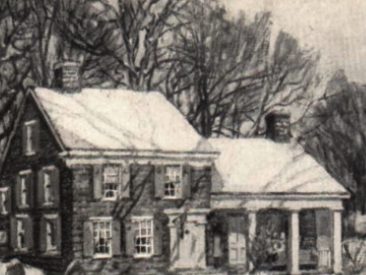
Next day Mrs. Stapleton took me to visit the Paine Museum, which is shared with the Huguenots, refugees that had fled from religious persecution in France. The museum is in Paine’s cottage, which had been moved from its original site. The museum has a lecture hall which has a portrait of Paine and houses a bust of him and several relics. There is also a splendid library where we spent an all too brief two hours. Near the museum and not far from where Paine had been buried is a monument to him, erected in 1839.
The following day I paid a return visit and heard an interesting talk from the President of the New Rochelle society about Paine and women’ s rights. On the Friday I ventured alone into New York to visit the United Nations, though the weather left much to be desired. At the United Nations I sat in on a debate about disarmament. I also joined a tour of the building which prompted me to conclude that despite all its weaknesses the United Nations has achieved a lot over the past forty years. The remainder of the day was spent in the City Museum of New York for a Thomas Paine browse.
On the Sunday I visited a Baptist church for what turned out to be a three hour spiritual jamboree. I thought Thomas Paine would have been pleased to see ladies all dressed in white taking a prominent role in the service, with a black lady preacher, and when they asked visitors to stand up and announce themselves, there was a round of applause when I told them I was on a “Paine pilgrimage”.
In the afternoon I attended the AGM of the Thomas Paine— Huguenot Historical Society, at which I was invited to address the members. I congratulated them on the splendid way they guard and promote the Thomas Paine image, and the devoted manner in which they shoulder their responsibilities. I concluded my address with my “Human Rights Missionary Man” song. President Cooper, in his address to the society, reported on a visit to Paris he had made for the rededication of the Paine statue there. A proposal I made for support for an exchange visit in 1991 was well received. After the meeting a few of us went on to the splendid Thomas Paine Hotel at which we had “Tom Paine pie”.
WASHINGTON
Our member David Henley drove me to Washington, stopping at Fort Lee, Morristown, where stands a magnificent statue of Paine in a lovely setting that any Paine enthusiast should make every effort to see. This statue should really be in Washington itself. We then went on to Bordentown to visit Paine’s house there, which has been occupied for over sixty years by the charming Valentini sisters, both TPS members, who were most happy to see us. Another keen member of the TPS who lives in Bordentown, George Earle, came round to meet us and took David and I to see Col. Kirkbride’s grave and monument. Mr. Earle took us out to dinner and it was 11.30pm before we eventually reached Washington and there I met David’s charming wife, Nancy. David Henley is a great admirer of Paine and has collected many interesting items related to him. He has made a detailed study of Paine portraits, and has an unrecorded example in his collection, perhaps the one Col. Trumbell presented to Jefferson in 1789. David supports the hypothesis that Paine wrote the letters of Junius, and had a child by his first wife, which he considers was adopted.
In Washington I took in the usual round of tourist sites. In the Smithsonian Institute I saw a model of Paine’s bridge. In the Capitol there was no trace of any gratitude for Paine’s role in the formation of the United States apart from a minor ceiling painting. A visit to the National Library allowed me to inspect original Paine documents and hear tapes of quotations from Paine used in the last war to encourage men to enlist in the services. These included Basil Rathbone reading the famous passage starting: “These are the times that try mens souls….” It was a pleasure to have dinner with Frank Smith, author of Thomas Paine Liberator, and Herbert Manius, who offered to help with the 1991 exchange proposal.
PHILADELPHIA
I went to Philadelphia by Greyhound coach, a journey of three hours. This was where Paine began his great work. I stayed at a youth hostel set in glorious parkland a few miles out of the city, where I met a party of Estonians and had a long discussion with one and distributed Paine literature to the rest. My first venue in Philadelphia was Independence Hall, a picture of Paine hangs there. Next I visited the Philosophical Society to inspect the Gimbel Paine Collection housed there. Looking at the original letters and other material made me realise just how close Paine was to many leading figures in three countries.
Benjamin Franklin is well commemorated in Philadelphia, and a modern “shrine” to him is found at the site of his family residence. Here is shown a sugary film about his life and recorded conversations take place between models dressed in period costume which rise from beneath the floor. The centre has ingenious computerised devices to stimulate visitors, and it was good to find that Paine’s role in American history was not ignored, but there is no portrait of him and no postcards showing him available at the shop. A visit to several other historical places in the city revealed that Paine is not portrayed in any, nor is it known where he lived, however, most of those I spoke to seemed to know something about him, though many were still ambivalent in their attitude to him.
So it was then back to New York, where I had the unpleasant experience of having my pocket picked at Grand Central Station, and discovered the New York police to be particularly unhelpful, to put it mildly. I wrote about this to the Mayor of the city, and also to the “Philadelphia Public Enquirer” about that city’s general lack of public recognition of Paine’s heroic stand for American independence (the letter was, I understand, published). In Washington, I noted a statue of Edmund Burke.
I must express my heartfelt thanks to Mr & Mrs Stapleton, Mr & Mrs Henley, Ann Kalloudis, George Earle and the members of the New Rochelle society for their great help. An added bonus was to bring back a splendid bust of Paine by Gabriel Pierro, rescued from New Rochelle Town Hall by Mrs Stapleton, which will be “installed” at the “Bull”, Lewes, next year by our new Vice—Presidents, Mr & Mrs David Henley as a gift from the United States.
In all my “pilgrimage” was a truly memorable and Paine-expanding experience, which should hopefully make me more effective in talking about and working for the great man’s ever continuing cause.