
By R.W. Morrell
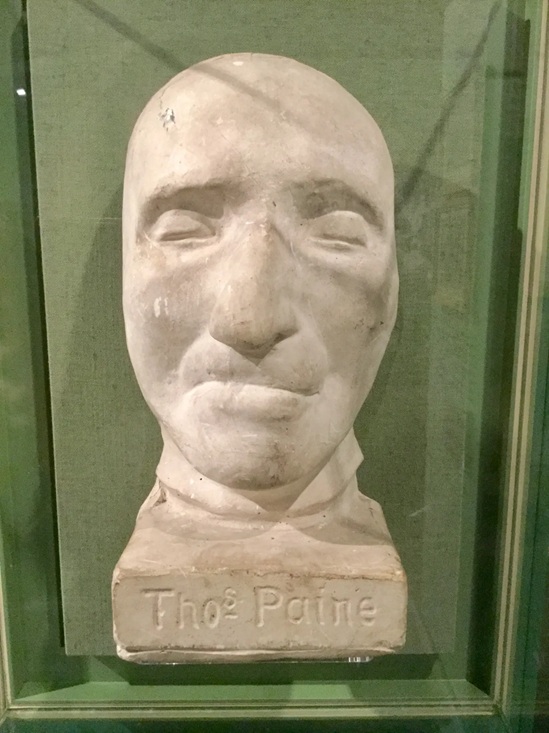
The possible influence of Thomas Paine frightened the political establishment of Britain, and one of the means taken to influence public opinion against him was character assassination, another was to inflame prejudice against him amongst those who ironically would have had most to gain from the implementation of these ideas.
One of the methods used was to hang or burn effigies (or do both) of Paine, and this sort of thing took place in a great many places throughout England. Two examples of this I have recently come across and record them here.
According to “The Date Book” (Nottingham, H. Field, 1880), on February 12, 1793, “the infamous Thomas Paine (one of the rag-a-muffin Convention of Paris), was apprehended and lodged in the Peveril gaol at Lenton, near this town (Nottingham); he was brought to trial the same day, and after a fair and impartial examination (his crimes being so big with infamy he could not plead!) he was found guilty…” Paine, or the effigy used in the farce, was sentenced to hang, after which those taking part retired to a local coffee house for refreshment. In the evening the effigy was burned on a bonfire. Prior to the burning, a party of Paine’s supporters had tried to cut down the effigy but were attacked by the anti Paine mob. After the burning the mob once more retired to a coffee house, which appears to have supplied them with drink rather more potent than coffee, presumably at the expense of a local landowner, Lord Middleton, whose health was repeatedly toasted.
The account also mentions effigies of Paine having been adorned in some other parts of Nottingham with a cabbage under one arm and an old pair of stays under the other, and whipped through the streets. Reference is also made to a local tradition of Paine having worked in Nottingham (p.185). Despite the burning and hangings of Paine’s effigy in Nottingham, there seems to have been considerable pro—Paine feeling in the town.
The second report I want to refer to I found in issue No.14 of Strapetona (1987), the magazine of the Thrapston District Historical Society (Northamptonshire). Amongst some notes collected together by the Rev.Henry Ward, a local clergy in the 19th century, it is recorded that an effigy of Paine was mounted on a donkey and paraded around Titmarsh, after which it was gibbeted and burned, one of the bystanders also fired a shot at the effigy. Another account of the same event speaks of the effigy being put in the stocks on the village green and shot at by several of those present before being burned nearby. One person who witnessed it said the effigy “was dressed in good clothes” and thought it a great pity to burn them.In Thrapston itself an effigy was paraded up the main street followed by a large procession and eventually burned in what was called the Round Pasture.