
By Ann Kalloudis
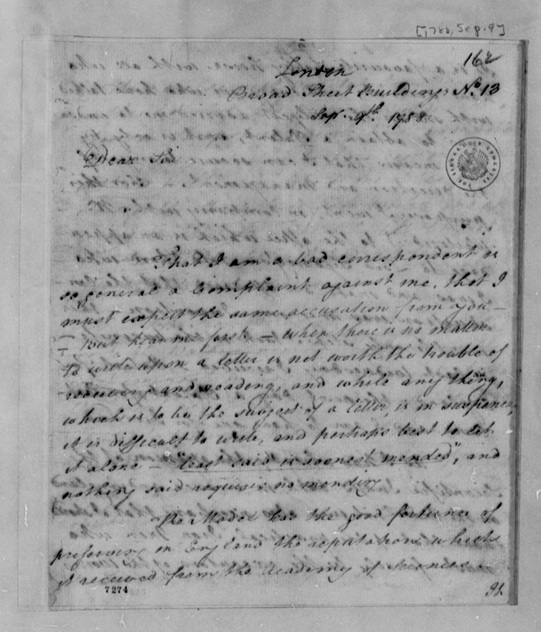
Image above is the front page of the September 9, 1788 letter from Library of Congress
THOMAS PAINE was a pioneer in the use of iron for bridge building. Thomas Jefferson shared his interest and both corresponded on the subject. From a letter from Paine to Jefferson, from London, September 9, 1788:
The model has the good fortune of pressing in England the reputation which it received from the Academy of Sciences (Paris). It is a favourite hobby horse with all who have seen it, and everyone who has talked with me on the subject advised me to endeavour to obtain a Patient, as it is only by that means that I can secure to myself the direction and management. This is the only step I took in the business.
Last Wednesday I received a Patent for England, the next day a Patent for Scotland, and I am to have one for Ireland. As I had already the opinion of the scientific judges both in France and England on the model, it was also necessary that I should have that of practical Iron men who must finally be the executors of the work. There are several capital Iron works in this country, the principal of which are those in Shropshire, Yorkshire, and Scotland. The Iron works in Yorkshire belonging to the Walkers near to Sheffield are the most eminent in England in the point of establishment and property. The proprietors are reputed to be worth two hundred thousand pounds and consequently capable of giving energy to any great undertaking.
A friend of theirs who had seen the model wrote to them on the subject, the two of them came from London last Friday to see it and talk with me on the business. Their opinion is very decided that it can be expected either in wrought or cast Iron, and I am to go down to their works next week to erect an experimental arch. This is the point I am now got to, and until now I had nothing to inform you of.
If arches can be extended in the proportion the model promises, the construction in certain situations, without regard to cheapness or dearness, will be valuable in all countries.
Paine replies to a letter from Jefferson on February 16, 1789:
My intention at the time of writing to you was to construct an experimental arch of 250 feet, but in the first place, the season was too far advanced to work out of doors and an arch of that extent could not be worked within doors, and nextly, there was a prospect of a real Bridge being wanted on the spot 90 feet extent. The person who appeared disposed to erect a bridge is Mr.Foljambe nephew to the late Sir George Saville, and a member of the late Parliament for Yorkshire. He lives about three miles from the works, and the River Don runs in front of his house, over which there is an old ill constructed bridge which he wants to remove. These circumstances determined me to begin an arch 90 feet with an elevation of 5 feet. This extent I could manage within doors by working half the arch at a time. A great part of our time, as you will naturally suppose, was taken up in preparations, but after we began to work we went on rapidly, and that without any mistake, or anything to alter or amend. The foreman of the works is a relation of the proprietors, and excellent mechanic, and who fell into all my ideas with great ease and penetration. I attended at the works till one half the rib, 45 feet, was completed and framed horizontally together and came up to London at the meeting of Parliament on the 4th of December.
In point of elegance and beauty it far exceeded my expectations and is certainly beyond anything I ever saw. My model and myself had may visitors while I was at the works. This bridge I expect will bring forth something greater, but in the meantime I feel like a bird from it’s nest and wishing most anxiously to return. Therefore, as soon as I can bring anything to bear, I shall dispose of the contract and bid adieu. I can very truly say that my mind is not at home.
July 13, 1789 letter to Jefferson discussing costs and constructional matters and asking a favour.
I am to undertake all expense from that time and to complete the expecting. We intend first to exhibit it and afterwards put it up to sale, or dispose of it by private contract, and after paying the expenses of each party the remainder to be equally divided, one half theirs, the other mine. My principle object in this plan is to open the way for a bridge over the Thames.
I shall now have occasion to draw upon some funds I have in America. I have one thousand dollars stock in the bank at Philadelphia, and two years interest due on it last April. £180 in the hands of General Morris, £40 with Mr.Constable of New York, a house at Bordentown,’ and a farm in New Rochelle. The stock and interest in the bank which Mr.Willing manages for me is the easiest negotiated. I shall be very glad if you can manage this matter for me, by giving credit for two hundred pounds on London, and receiving that amount of Mr.Willing. I am not acquainted with the method of negotiating money matters, but if you can accommodate me in this, and will direct me how the transfer is to be made, I shall be much obliged to you. Please direct to me under cover to Mr.Trumbull. I have some thoughts of coming over to France for two or three weeks, as I shall have little to do here until the bridge is ready for erecting.
On September 15, 1789, Paine expresses his gratitude to Jefferson:
When I left Paris I was to return with the model, but I could now bring over a complete Bridge. Though I have a slender opinion of myself for executive business, I think, upon the whole that I have managed this matter tolerably well. With no money to spare for such an undertaking I am sole patentee here, and connected with one of the first and best established houses in the nation. But absent from America, I feel a craving desire to return and I can scarcely forbear weeping at the thoughts of you going and my staying behind. Accept, my dear Sir, my most heartily thanks for your many services and friendship. Remember me with an overflowing affection to my dear America, the people and the place.
I shall be very glad to hear from you when you arrive.
I remain yours affectionately,
– THOMAS PAINE